"You'll never get ahead if you don't take care of what you have." - Doris Waddell, RIP

The late Ralph E. Williams with "Heidi" - morris mn

The late Ralph E. Williams with "Heidi" - morris mn
Click on the image to read Williams family reflections w/ emphasis on UMM.

Sunday, April 8, 2012

Just when color-blindness seemed attainable

A new generation lives in a world that in many ways can be scarcely understood by the older folks. This is true in many ways, one being race consciousness.
The young seem to hardly notice race. At least this is my perception. I'm writing this as one of the older folks.
My fellow boomers and I dreamed of a world like this. Our desired world is one in which race-based terminology seems hardly needed. People are people. We have the Martin Luther King holiday as a backdrop of inspiration.
I have wondered in the past couple years (I believe even on this site) if the MLK holiday is even desirable. Perhaps it reminds us of things that are best left relegated to textbooks. I have suggested it might be patronizing.
It even seems to be morphing into something different than the original intent. It has taken on a sub-name of "Day of Service." This is something young people can attach themselves to.
I grew up when the term "Negro" had currency. Race seemed more a question of white and black. Today the race spectrum has so many who are away from the extreme. The laws are pretty firm against any sort of discrimination. Asians have more of a presence.
We are rapidly destigmatizing the gay community whether Rick Perry likes it or not. He will want to forget about his dated views just like he seems to forget about other things. A little more painkiller might help.
Race and lifestyle have rapidly faded as ways of labeling people. Our youth grow up in a diverse and liberated world. They're smart enough to see something can still be amiss at times. Like, the unreasonable hatred vented by a segment of our society toward Barack Obama.
Young people see this and I hope they know where a lot of it comes from. It spews from older people who grew up in a more race-conscious world. Is the president a Negro? I would say not. Is "Negro" supposed to be capitalized? I'm only following an instinct.
When I was a kid I heard the term "Mulatto." We were supposed to attach it to people "who seemed sort of black." There was a time when part Native Americans were called "halfbreeds." The very need for such terms would befuddle today's young. Or at least this is how I size things up.
Then we get the Trayvon Martin (alleged) murder. It's a wakeup call for kids who might need a reminder on how things used to be. In just a few seconds, a guy who seems to have psychological problems undertook an impulsive act that has gripped the media. It has become a mega story along the lines of Chandra Levy and Terri Schiavo.
The Martin execution seems troubling from several angles. As we digest this story we realize that "suspicious behavior" comes in many forms. I'm sure we have all recalled times when we were accosted by law enforcement for groundless reasons.
George Zimmerman was "law enforcement" in only the most quasi way. He was a "neighborhood watch captain." I have not heard of such a thing among our small communities in western Minnesota. Nor do we have "gated communities."
Charles Bronson made the "vigilante" seem glamorous. I was troubled by the appeal of those movies. They seemed totally unrealistic. The "bad guys" were bad in a totally Hollywood type of way.
The way Bronson wasted so many people would never be given a pass by real society. I hope people realize it's totally make-believe.
Look at the huge swirling tempest over Zimmerman taking one life. Trayvon Martin appeared to be walking along minding his own business. But he was black. He was young. He wore an article of clothing apparently associated with shady activity, although when I was young, bluejeans were considered a little subversive. Today people wear them in church. Men wear them with suitcoats.
Judging people by articles of clothing can be totally folly. In Martin's case we have the "hoodie." In Minnesota we have hoods available to keep our ears warm.
Being a black young man apparently has its hazards around a gated community. He might steal something. Even if he did, is this cause to "waste" him Bronson-like?
Zimmerman behaved in a way that showed he had confrontational intent. He has a history of anger management issues. He has a history of getting lenience from the legal system. Is this because he's from a family that works in the legal/law enforcement system?
I would suggest the earlier leniency is the biggest angle we might have to look at here. More appropriate intervention at an earlier time could have prevented this. Now we have a festering mega story which focuses on much broader issues than one unbalanced person "freaking out." We're back on the fundamental topic of race.
The only good thing that can come out of it is greater racial sensitivity and enlightenment. Oh, there's something else: We can discard this "stand your ground" law and other such right wing-inspired legislation, much of which may have been progressing under the radar. It passed without Jeb Bush paying much attention.
Young people are far more enlightened, not like politicians who are listening to sources of special interest money. The young shall lead. Hopefully they'll extinguish vestiges of racism and the kinds of proposed legislation coming from the likes of the tea party, NRA and ALEC.
We can only pray. And let's pray for justice in the horrific Martin-Zimmerman case.
Rick Scott is the governor of Florida and don't look for him to be a leader. We are reminded of the Deep South and its traits. Let's remember that when it comes to the Deep South and its historic defining traits, it is never the winner.
We have a captured Confederate flag in Minnesota as an artifact. It was kept through some sort of slip-up. It's from the battle of Gettysburg.
"They lost," Governor Jesse Ventura said (re. the South) in his classic non-subtle style. This was when the question arose over whether we should "return" the flag to a reenactors group in Virginia. The state of Virginia wants nothing to do with it.
We progress from race consciousness in fits and starts. I think we know what way destiny will take us.
- Brian Williams - morris mn minnesota - bwilly73@yahoo.com

Wednesday, April 4, 2012

Can religion rein the "nones" back in?

C-Span2, otherwise known as "Book TV," can absolutely come to the rescue on weekends when cable TV seems so weak.
"Book TV" at its best is the absolute best TV you can find. It completely contradicts what Newton Minow once famously said about television, that it was a "vast wasteland."
C-Span2 allows you to sit in on lectures and discussions that you might consider driving a fair distance to attend. They'll just set up a camera at a bookstore or lecture hall and let the event unfold. They aren't scared of an occasional minute of "dead time" when nothing is happening and people are just milling about in the room.
That's a trademark of the C-Span channels. Chris Matthews of MSNBC talks about how "incremental" it is.
When a book author is discussing something of particular interest to me, I sit transfixed. It makes you think, analyze and want to raise your hand to ask a question yourself.
On Sunday (4/1) there was a fellow talking about the increasing number of people who identify themselves as nonreligious. The analysts call these people the "nones," not to be confused with "nuns," because they answer with "none" when asked what religion they subscribe to, the speaker said. The number is getting up close to 20 percent.
I suspect the term "atheist" isn't used because atheism denotes an active doctrine, whereas the people answering "none" really aren't pressing the matter at all. They probably wouldn't be any less irritated (not much anyway) by PZ Myers than anyone else.
Myers is one of those academic atheists. Academia has plenty of its own problems without concerning itself with, or confronting, organized religion. We only listen to Myers because he has a position in academia.
For those of you not familiar, he's associated with our own University of Minnesota-Morris. I wouldn't be surprised if he has caused considerable hair-pulling among administration. We hire people like Myers, academicians that is, to help shape young minds.
The speaker on Book TV reported that the apparent flight from religion is especially marked among the young. He used the term "millennials." He had a theory about this that I respect, but I personally think at least one other strong force is at work.
The speaker talked about the blending of religion and politics.
When did this begin? Was it when Republicans started taking over the Deep South? As a kid I remember hearing the term "the Democratic solid South." Today the region with all its evangelical Christianity is quite Republican, Jim DeMint-style.
Can we suggest that Jerry Falwell's Moral Majority got the ball rolling?
I remember a very nice Baptist couple in Morris, very well-intentioned, who dug in their heels as members of the local Republicans. Nice they were, but they were hard right-wingers.
I find it hard to say anything disparaging about the locals as long as they never did anything that was really in-your-face. Still, the type of people I once associated with the local Republicans - temperate folks - drifted away. These were your typical middle-aged people who were business-oriented and cautious in their sensibilities. Paul Stark wouldn't mind if I typed his name here.
These people had an ideology but it wasn't flaming. Evangelicals decided it wasn't enough to just profess their beliefs in the church pew. If they were real believers, or so they felt, they had to get engaged in politics.
Non-white religious leaders still felt comfortable in the Democratic Party. But the whites gravitated Republican, or they sure made the most noise. The fellow on Book TV suspects this says much about the drift away from organized religion among the young.
Many of the young who are alienated by the chief tenets of the far right have their attitudes about religion colored. They aren't in the pews as much. The people who make their living in religion have seen this. That is why there is a current effort to gain more separation between religion and politics, from people inside.
Is it too late? You see, I think other forces are at work too. We live in a totally knowledge and information-driven age. Allow me to explain:
Church has historically been an important way for people to "network." The World War II generation was great for believing in clubs, organizations and churches giving great fulfillment. Bless them.
They did believe in the aims of these groups. But there was also a self-interested base in their activities. Belonging to the Elks Lodge or veterans club was a way to keep your place in the community, enhancing basic job security. "Who you knew" was important.
Today the criterion of "what you know" is absolutely paramount. As the number of menial or tedious jobs goes down, the need to master new data management tools takes over as whether you sink or swim.
It doesn't matter so much what church you go to. It doesn't matter if you drink to excess at an Elks club on Saturday. It won't get you anywhere. It's bad for your health and safety, which it always has been.
Better to stay home, get your proper amount of sleep and be absolutely certain you keep up with all the tech-driven changes that are most certainly affecting whatever occupation you're in.
There's no guarantee you'll survive. But the old-fashioned way of networking isn't likely to help you at all. It isn't who you know, it's what you know.
This also explains why it's less important to dress in a "formal" sort of way.
The decreased emphasis on dressing "formally" in church has been noted for some time. People my age discuss this with amusement. We'll make note of some people dressing "grubby" for church, which in a previous age (like in our youth) would have brought great disapproval.
As the "information age" began cutting its swath in our society, the mere act of choosing how to dress became less important. We were no longer putting on airs of being a certain type of person. Again, knowledge became everything. Adjusting became everything.
People who understood and could manage complex data systems landed on their feet. They "got it." Dressing formally or belonging to certain groups would become totally secondary.
I remember the character in the movie "War Games" who was the total computer nerd of his time. The hero went to him to consult, remember? He had the sidekick named "Melvin," a nerd to the point of eccentricity. Melvin's little quips got the Ally Sheedy character smiling.
The moviemakers were trying to tell us something - I have no doubt. The computer mavens paid no mind to their appearance or behavior and maybe not even to their hygiene. But we were supposed to admire them. They were on the cutting edge of what was coming for our society.
The Matthew Broderick character was able to stop a world conflagration and he of course showed up a lot of clueless and pretentious older folks in the process. Remember the general who talked about "pissing on a sparkplug?"
The young will always lead.
The fact that around 30 percent of millenials are "nones," professing no meaningful tie to religion, is interesting. That presenter on Book TV was fascinating, just like a later speaker in the day who had written a book about the final surrender of the Confederacy - all the twists and turns.
Book TV can rescue a blah weekend. My friend Glen Helberg is a big C-Span fan.
It's ironic we get bored by TV when so many channels are available. Sometimes I'll be channel-surfing and stop to watch one of those half-hour infomercials for a Time-Life music CD collection. Have you caught those? I'll often stay on that channel for the rest of the half-hour, even if it's a show I've seen before. I like the one with "Bowser" and the 1950s collection.
It says something that this programming often seems like the best available. Weekends are the "wasteland" as pointed out by Newton Minow, even though he was thinking more of shows like Gilligan's Island, and not "Huckabee," that strange Fox News prime time show that presents politics in a Tonight Show-like format.
The Huckster is a conservative Republican from the Deep South (Arkansas).
When will the conservatives' reign in the media finally end? One thing is for sure: Young people find the blending of right wing activism and religion unacceptable.
Hence they are "nones."
- Brian Williams - morris mn minnesota - bwilly73@yahoo.com

Saturday, March 31, 2012

Wisconsin festers and Gannett chokes

None of us pauses too much to think about the state of Wisconsin, where the sports fans choose to root for cities instead of the state.
The political focus is coming to the state with the Republican primary and the recall vote. The state of the Green Bay Packers, Milwaukee Brewers and Milwaukee Bucks will assume a higher profile.
Minnesota has teams named for "Minnesota." We assume that's the way it should be but we wonder why our neighbor to the east is different. Is "Wisconsin" a secondary identity?
Wisconsin seems in a world of hurt now with division. One wonders if Minnesota would be in similar straits if we had elected Tom Emmer. I'm surprised the Republican came as close as he did, and were it not for an old DUI issue he may well have gotten swept in as part of the Republican/tea party/reactionary wave.
Many of the people who pulled the lever for Republicans in 2010 thought they were voting for normal Republicans.
It wasn't unusual that the electorate would lean Republican in the off-year election. We had elected Barack Obama president and there was some hesitation over whether we really wanted the Democratic agenda to take over.
The electorate can be blamed for not getting properly educated. Maybe these new ID cards for voting should include some proof you're not voting impulsively.
People just assumed that Republicans were a predictable sort of animal. I mean, we have Democrats and Republicans and we'd like to feel they are all decent, rational human beings with manageable differences in terms of political philosophy.
They should be able to argue vigorously, even with a profanity or two, and then get together for a drink afterwards. A Pepsi.
This is the way politics used to be. The idealized model was Tip O'Neill vs. Ronald Reagan. I just cannot see Ronald Reagan among the fire-breathing goons who call themselves conservatives today.
Wisconsin is engaged in considerable soul-searching now as it ponders whether it really feels comfortable with the more hard-edged brand of Republican, which they apparently didn't know they were getting.
We have the Democrats who are a pretty known commodity. We have Republicans like Olympia Snowe who have fallen out of the mainstream of her party, hence her harried departure.
Then there is this weird third branch, which reminds me of an episode of the old Monty Python Flying Circus. The faux news program was reporting on an election that included not only the "Sensible" and "Silly" parties but an "independent Very Silly Party." When reporting the candidates' names of that latter party, this newsman had to use a noisemaker.
The very conservative activists among us might well be called "very silly." Wisconsin chose a governor from that category and things have been quite amiss there since. This individual is Scott Walker.
We now have the official nod for a recall vote. That's pretty drastic and pretty embarrassing for Wisconsinites, who'd love to just focus on Packer football.
What state in its right mind would want to be perceived as having had its head up a certain part of its anatomy in the last election? And what a huge and expensive distraction this is. Perhaps it's dividing families.
The type of people with pro-gun bumper stickers will back Walker. These people also shake their fist behind the "stand your ground" laws, the castle doctrine and voter suppression policies. The right wing industry swoops into the state with propaganda and intimidation tactics.
Is that an overstatement? Just think of the ridiculous effort to intimidate media organizations by finding out who among them might have signed the recall petition. I became aware of this when checking Fox News last week. There was a self-righteous talking head (a program guest) berating the "biased" media.
The petition regarding Walker got 900,938 signatures, while only 540,208 were needed. It was a totally legal process in which all citizens should have felt welcome to participate.
There are chain newspapers in Wisconsin that showed absolutely no spine in standing up to the pro-Walker cabal. I have to laugh because I would be astounded if a chain newspaper company showed any spine or conscience.
Chain papers know what the rest of us are slow in learning: that newspapers are businesses that live on advertising dollars, and their decisions are wholly grounded by that consideration, not by any particular journalistic ideals.
In other words, they scare very easily, like "Beaker" of the Muppets.
Businesspeople are scared very easily by conservatives. The Wisconsin papers of the Gannett chain felt they had to apologize. Because the petition signers were public information, and because zealous groups can comb through those names for purposes of harassment, it was learned that 25 employees among those Wisconsin papers signed the petition.
The suits that run the company prepared a column that was run in these papers under the names of local editors (lackeys). They went through the painful gymnastics of explaining that as a matter of principle, "journalists must exercise caution and not become involved with issues that may cause doubts about their neutrality as journalists."
Gannett claims that none of the "political activists" (my words) in their ranks are involved directly in political coverage. Even so, the ones who signed are seen to have committed ethical violations and are subject to discipline, the company says as it cracks the whip.
Of course, principle plays no part in any of this. The people running this newspaper company, in a business that is in a well-known retreat, are just scared. They absolutely don't want to confront the right wing harassers.
It's purely quaint to think journalists should be neutral. Besides, isn't not signing the petition a political statement?
What if Gannett's attitude spread to other companies? It would become a serious intrusion into our political process. Because the recall effort, however divisive it might be, has the imprimatur of the state. It's legal.
The truth is that reporters should report fairly regardless of their political beliefs. It doesn't mean they should be devoid of political beliefs.
Besides, wouldn't you really rather know the opinions of the writers whose work you are consuming? Much of the media today is in fact partisan media. There is a great market for it.
Meanwhile the staid old newspaper business draws a yawn as it fades into the sunset.
What about newspaper chains like the Forum of Fargo, owner of two papers in Stevens County, that actually endorse candidates? How would the right wing harassers in Wisconsin square that?
The Forum has a right-leaning reputation - can you name a left-leaning newspaper chain? - so the Wisconsin activists would pay no heed. Anything that furthers their agenda.
Isn't signing the recall petition just like voting - a citizen's valid option or duty (at least to take a side)?
Gannett rebuts this. The soulless bigwigs who pull the strings, who daily are in meetings on how to manage the newspaper industry's retreat, are saying the recall vote is too "emotional" to be viewed like this.
Emotional? It's a legal process. If certain people choose to become emotional, it's their problem.
Gannett says "the super-charged emotions should have been a red flag for journalists. They should have realized there'd be a public backlash."
There was no "public backlash." There was a carefully orchestrated cry of foul from the usual suspects on the right, people like Brent Bozell, ol' Redbeard, who has made a racket out of this kind of feigned outrage. It's a nice gig for him.
It's ridiculous to even talk about "media bias" today when there are a million voices out there. We just have to carefully choose what we consume. It's not hard to figure out what voices reflect a certain agenda.
Wisconsinites might well reject the recall effort because it just looks untoward, nationally speaking, to just yank a governor. It's embarrassing to admit the citizens of the state were misguided in the first place. They just didn't see they were electing a member of the "Very Silly" party.
This is a guy who has hired defense attorneys. There is an ongoing criminal investigation of former Walker aides.
The conflict in Wisconsin is being described as a "civil war." Did we in Minnesota barely miss ending up in the same or worse situation?
I'm surprised Republican Emmer came as close as he did. We could have ended up in a roiling political atmosphere here, in the state that once elected Walter Mondale and Paul Wellstone. Today we elect some people like we're South Carolina.
The partisanship of today is so severe, we can't even seem to reach a general agreement on the Trayvon Martin murder case. Oh wait, it might not be a "murder." The righties are taking pains - just watch Fox News - to get the shooter's side of the story as a way of protecting Jeb Bush from embarrassment.
It was Bush, generally considered "the smart Bush brother," who signed the Florida "stand your ground" law. Jeb applied the pen with an NRA official standing right behind him.
Floyd R. Turbo would have been proud.
We once laughed at Johnny Carson's Turbo character as being an ignoramus. Today these people are getting elected.
God save us from the "Very Silly" party.
- Brian Williams - morris mn minnesota - bwilly73@yahoo.com

Wednesday, March 28, 2012

Seductive mantra of "supporting education"

Who doesn't want to applaud when a politician talks about the need to "support education?"
The political people know that nothing makes them look more virtuous. They talk about expanded educational opportunity. Surely this is a plum or an ideal, right?
We're in the fifth year of a recession so maybe we need to start peeking under platitudes. Do we want to be creative about education or keep propping up a model that increasingly looks outdated?
Heaven only knows how education could be transformed if we just got out of the way and let creative destruction take effect.
There is a specter over discussions about how money is spent at institutions like the U of M. Our U just happens to have been in the news lately.
That specter is the "higher education bubble" theory. Not everyone agrees it's there, hovering in such a way as to cause considerable whistling in the graveyard. But what I read seems to have an awful lot of merit.
A bubble is a speculative boom and bust phenomenon. The rhetoric about the virtues of education covers up a dubious path where huge sums of money continue to get infused in this sector. The bubble has been kept up by government subsidies and to a certain extent foreign students.
Tuition is a burden. And debt loads? We're talking sleepless nights.
Politicians talk about expanding the supply of higher education. We applaud without critical thinking. Fundamentally what we fail to do is separate the virtues of actual learning from the bricks and mortar institutions full of pretentious human beings who demand ever more generous compensation.
This at a time when information systems have been transformed. We are drowning in information today. We should pinch ourselves to see if we're dreaming. How quickly we forget. Knowledge once seemed scarce which is why we needed all these institutions.
That scarcity is gone with the wind, and it's a tremendous blessing. No more need for "paper" encyclopedias. Hats off to those intrepid salesmen - they were pure Americana.
But what if we woke up one morning and realized we simply don't need college libraries anymore? Literally don't need them? Might that time have already come and gone? Have we not smelled the coffee yet?
I think the young people know exactly what's going on. When they're old enough to have power they'll see to it that our institutions are redesigned and streamlined to focus properly. In the meantime we talk about ridiculous largesse at our University of Minnesota.
It's our beloved U of M of course. We're supposed to look at everything through rose-colored glasses. If an institution stands for education it's supposed to be above reproach, right? This is the fog of rhetoric that irritates me.
Yes, I have some friends who smirk a little because they think I'm just so cynical. Have they read Charles Murray? We ignore his insights at our peril. We're all too eager to ignore his insights as we tout whatever alma mater we come from. We wear our college beanies, at least figuratively, and pledge allegiance while ignoring the forces of change that are bubbling up.
The real estate industry tried resisting change. The Internet enabled new and more efficient models that actually benefited home buyers and exposed scam-like flaws in the existing system.
The Texas legislature, as reported in a noted TV documentary, passed laws to try to protect the legacy system with its largesse for the insiders. Those hugging the status quo weren't eager to have media people around. I was heartened when I heard a respected analyst say "eventually the barriers will come down."
The Internet has that kind of effect: It seems to break down all barriers. Kids see this and absolutely cheer for it. They cuss when they see older people try to put up restrictions as with onerous intellectual property rules. The "forces for good" won with the recent retreat of SOPA and PIPA.
Yes, the barriers eventually come down. Only a fool can't see that this transformative democratization of knowledge isn't going to have a big effect on legacy education models. The ivory towers won't just come down, they'll be ignored.
Politicians preach that "jobs of the future" are going to require degrees. Of course these same knaves smiled on the expanded supply of "affordable housing." There is a siren song imploring us on security and insurance against the future. Hence the housing bubble.
And in the future, "education."
I put "education" in quotes because I'm talking about the legacy system of bricks and mortar and the entitled-feeling people who run them and preside in classrooms like they're performers, which they are. We hear the seductive mantra about "supporting education." It seems like a pie in the sky promise.
We once were convinced housing prices would always rise. Similarly we look with an inadequate critical eye on the platitudes about "education" (again, with quote marks, not to be confused with real learning which is nothing but laudable).
Holy cow, we're told the "jobs of the future" will require all this special learning. Our little morning coterie at the Morris McDonald's has discussed this. I have asserted that the "jobs of the future" pronouncement is absolute poppycock.
I have an ally in Paul Krugman (the economist, not a regular Morris McDonald's patron). Krugman is a pariah for those who watch Fox News, and for me this increases his credibility. He takes on the popular wisdom that tech progress puts refined knowledge at more of a premium.
Shouldn't Krugman's conclusion be rather intuitive? Don't we live in a Wall Street-driven culture? Isn't it quite basic that the captains of industry are going to use technology to "dumb down" the jobs they offer? Aren't they judged purely by the bottom line?
Don't they use the likes of Fox News to beat down any notion that we need taxation to lift up our society?
They owe favors to no one. They will salivate as they discover tech shortcuts to trim workforce and make jobs as basic as possible.
Krugman argues that tech progress will reduce the demand for high-end jobs, not just the low-end. We have harnessed computer software to perform tasks that once called on throngs of pretty well-educated and specialized people.
Tom Friedman argues we'll still need "the butcher, the baker and the candlestick maker." But can anyone feel safe now?
(BTW it'd be neat if Krugman or Friedman could join us at McDonald's some morning.)
My friend who sells ads for the Willmar radio station says "everyone seems scared." Have you noticed that too?
Post Office jobs were once the epitome of safe and secure jobs. So many postal workers were likable veterans, models with how they lived their lives. But the Postal Service now has vultures circling over it daily.
Can our overbuilt system of colleges dotting the landscape really feel any safer? To their credit, they have weathered the storm thus far. Is there a tsunami coming?
I remember reading a personal thinkpiece by a Star Tribune writer who said "we all know" there's a tremendous amount of waste and duplication between the University of Minnesota and the state university system. Really? "We all know?"
If that's true, hang on to your hats. Even Democrats are going to be comfortable with this (efficiency push).
We thought Steve Sviggum might be of the type with a mission to push austerity with education. He's a Republican and those folks can be like a bull in a china closet - good rhetoric but with a horrible grasp of execution. Sviggum was forced off the U of M board of regents because of a conflict he should have easily recognized.
Democrats know that if large, bulky and amorphous education institutions lose their credibility, as the U of M might, their whole premise of promising a reliable if interventionist government could be threatened. Whistling in the graveyard indeed.
The U of M has been hung out to dry recently. U President Eric Kaler, his honeymoon having been crushed, announced that fossil Joel Maturi will be paid $352,000 in the year after he retires as athletic director. Ten other U executives have gotten a combined $2.8 million as "parting gifts" upon retiring, according to the Star Tribune.
The Star Tribune does have some fight left despite being part of a famously declining business model itself.
The U's Robert Bruininks, a favorite out here on the prairie because of his fondness for the UMM Jazz Festival, unfortunately looks like an insider with the predictable parochial instincts. Having been in the U since 1968, and having concluded a stint as president (a quasi-royal role in Minnesota), he's a good old boy with all the protections and benefits of the doubt that status confers. Up to a point.
The information age makes it much tougher for the entitled-feeling folks. Bruininks - why can't he just spell his name "Brunix?" - has funneled a huge sum to an ungodly bureaucratic monstrosity (it appears) called the Center for Integrative Leadership. Whew.
The people who crafted this entity are of the same stripe that designed our "green community" here in Morris, for our old school property. It has won an award.
I have written that our "green community" is like the rabbit "Harvey" in the Jimmy Stewart movie of the same name.
We are all waiting with baited breath, I'm sure, to see what "integrative leadership" can do for us. Or maybe not.
It's a heckuva career transition plum for Mr. Bruininks and some of the small fish who accompany him. Equally bloated are these "executive transition leaves" that we're not supposed to pay much heed to.
The windfall for that integrative thing came from "presidential discretionary funds." OK, let's call it a slush fund. The gods up on Mount Olympus pull the strings. Not much need to peek around. Well, in the old days that mindset worked. This was back when we had encyclopedias.
All the windy talk about the virtues of a formal education will work to a point, but it's losing potency, I feel, as we speak.
We have indulged Wall Street somewhat up until now. That's partly out of fear. George W. Bush felt we "had" to pass TARP.
Unfortunately the notions of elitism promoted by Wall Street crept into our culture as a whole, so we get these ridiculous compensation packages for a self-defined "elite" at our colleges, ironically at a time when we are drowning in information (i.e. the fodder students consume) due to our new age.
We have the delusion that because certain people seem special, they deserve dizzying compensation packages.
The U says it has to attract top talent. Fine, but if the U is in fact blessed by such genius, why do we have these revelations that are causing such concern by the regents now? Can't these talented people be prudent? Do they need the regents holding their hand?
If so, it's rather scandalous.
The embattled insiders would say only one-third of the U's budget comes from tax dollars.
You could argue that the masses who continue to cover a substantial part of the U's expenses shouldn't have to pay anything to anyone who doesn't have a readily demonstrable need.
"Let's reduce tuition for the non-elite," writes Tom West of "West Words."
The man from Stony Brook (Eric Kaler) says he "expected" the Maturi package to be controversial. Really? He proudly states he didn't "hide" from the controversy. But if he feels his decisionmaking was truly sensible, should he really have anticipated "controversy?"
Who cares if Maturi's role is privately funded? Those private funds could be directed elsewhere. He's a good fundraiser? Is that such an exclusive talent?
The man from Stony Brook says "as promised in July, I'm holding the line on administrative costs." He adds: "Leading a culture change at this or any university takes time."
But my whole point is that time may not be on the side of our legacy education institutions, who likely face an encyclopedia-like future. Shudder? Accept it.
I already have, as I'm a refugee from the newspaper industry.
- Brian Williams - morris mn minnesota - bwilly73@yahoo.com
Saturday, March 24, 2012

Trekking to the west near the (future) Morris

A sign along the narrow and winding roads out by Wintermute Lake reminds of the oldest chapter in our community's history. (Photo by B.W.)

I would bet most long-time Morris residents have never seen Wintermute Lake. It can't be seen from any artery for transportation. There are few clues along Highway 59 North that you're passing a lake.
You can get a glimpse of the lake from dirt roads that aren't the best. If you pass by Heartland Motors and keep going north you'll see it.
That road is a short distance from where I live but I rarely take it. I took it once going out to the chili feed for the annual predator hunt. I wanted to mutter some bad words under my breath about how poorly maintained the road seemed in winter.
My point is that Wintermute Lake seems remote. It seems like a typical obscure Minnesota lake. There seem to be no recreational possibilities. But any lake affords aesthetic pluses.
Some nice homes are out there, located in a scattered sort of way. That's the way development seems out along Highway 59 North: scattered.
Some very narrow but paved roads wind out and around at Wintermute Lake. "Sunday drivers" should be aware you might end up at a dead end. You could end up in the yard or driveway of Roger McCannon. The McCannons have a nice tucked-away residence that gives you a great view of Wintermute Lake and its still pretty much untouched surroundings.
You might want to close your eyes and imagine how the intrepid 19th Century settlers headed west saw it. Wintermute Lake may seem like a non-descript Minnesota lake but it's significant historically. It was a backdrop for the Wadsworth Trail.
As a kid my first reaction to hearing of this trail was to think of Henry Wadsworth Longfellow. No connection. The name inspiration was from General James E. Wadsworth, Civil War general.
The Wadsworth Trail proceeded to Fort Wadsworth, west of present-day Sisseton, South Dakota. Things were pretty quiet out here on the pristine prairie in the mid 19th Century. What a blessing that was, compared to the stuff going on back east.
The Wadsworth Trail and the fort were established in 1864. It was the last full year of the U.S. Civil War, the unspeakably bloody conflict. The kind of conflict that happened at Spotsylvania Courthouse showed human beings at their worst.
Some of the most uncivilized conflict was inland quite a ways in what was then called the "west" like in Kansas. The movie "The Outlaw Josey Wales" was very instructive. What demons lurk in our souls sometimes?
West Central Minnesota was too remote to be touched by any of that. The Sam Smith statue reminds us of our ties to the Civil War. But Sam did his fighting in the east, then came out here to live a peaceful life.
Morris history really begins with Gager's Station, a collection of log buildings amidst the trees near Wintermute Lake. There were several barns and a building to accommodate travelers. The post office there was called "potosi" - a wooden box with pigeon holes.
Other features were a blacksmith shop and grog shop. It was the temporary county seat.
The first general election here was in 1868. The people heading west in that time were a fascinating assortment. They were willing to endure a substantial risk in order to try to find a new life.
Many of the protections of a civilized and well-ordered society faded or disappeared as one plunged into the interior of the continent or began the trek across the seemingly endless plains.
The east was much more developed, to be sure. The U.S. Civil War contradicted that attribute. The South after the Civil War was a smoldering and dangerous mess. Up here, European civilization was just starting to stretch its legs.
The Wadsworth Trail cut through Stevens County in an east-west direction. The trail wasn't totally fixed, as adjustments were made depending on the season, weather and road conditions.
The people taking the route embraced adventure. I'm reminded of Arthur Fremantle, British observer with the Confederate Army at the height of the Civil War, who described the inhabitants of Texas in the same way. He listed all the categories of fascinating people, in a conversation with General James Longstreet.
Fremantle saw Texas because his options for entering the country were limited by the Union army.
He might have been describing patrons of the humble grog shop at Gager's Station - nothing more than a keg of whiskey and a glass, overseen by a Swede. There wasn't even a shanty or tent.
The land offices were humming in Alexandria and St. Cloud. The first real settlement here was in 1866, in Framnas Township. The U.S. government christened the Wadsworth Trail. The trail had its role in county history from 1864 to 1871.
The wide spectrum of folks you encountered along the trail were a hint of the kind of melting pot America would become. No inhibitions and no aristrocracy. America was free soil.
Colonel Fremantle, who made his name with the Coldstream Guard, could have been listing intrepid folks along our trail. There were government supply teams, traders, "soldiers of fortune," gold seekers en route to the Black Hills, Native Americans with their dogs and ponies, and of course settlers.
The stated purpose of the Wadsworth Trail was to transport supplies from St. Cloud to Fort Wadsworth near present-day Sisseton. Fort Wadsworth became Fort Sisseton in 1876.
The Wadsworth Trail got established as cannons roared in the eastern U.S. The fate of the Union hung in the balance. It seems the South was simply resisting destiny. General U.S. Grant launched "total war." The secretary of war was Edwin Stanton whose son Lewis came to Morris to live. The cannons finally fell silent.
One would expect some conflict to the west where law and civilization were so fledgling. Think of "North Fork" in the TV series "The Rifleman" (with Chuck Connors, perhaps the best western actor ever).
Today the law penetrates into all aspects of our lives, to our annoyance sometimes (as with wearing seat belts). Imagine back when law was hardly established. A territory couldn't become a state until the law could be asserted without resistance.
The people using the Wadsworth Trial had fresh memories of the Sioux uprising. It has been called the "Minnesota massacre."
There was a fear the Sioux might join hands with tribes further to the west. Soldiers were dispatched out here to try to quell any such resurgence in hostile efforts. European settlers needed basic protection.
The Wadsworth Trail was a stage route. (I remember a stand-up comic once who mused on western movies and how a female character would step out of a stage absolutely exquisite in appearance, when in fact there must have been considerable dust and dirt.)
Transportation evolved. In the early days of the fort, supplies and equipment came up to St. Cloud on the Mississippi River. After 1866 the rails took over with the St. Paul and Pacific Railway.
Proceeding from St. Cloud into what must have seemed like a "great unknown," the route followed the already-established Red River Trail. This proceeded to Sauk Centre. There a new path was carved out, destination Glenwood. It snaked around south of Lake Minnewaska and came out here through present-day Hodges Township.
But as stated previously, it wasn't fixed. The travelers eventually preferred skirting Lake Minnewaska on the north side, and they arrived here through the northern part of present-day Framnas Township.
I have read that Gager's Station was a stopping place of some distinction along the trail. Part of me wants to dismiss that as back-patting for us. But let's assume it's true.
Henry Gager got established here in 1866. The location was Section 12, Darnen Township. This was merely temporary. The next year saw him re-locate to Section 12, Morris Township, adjusting to the more northerly route. Log buildings sprouted. A small trading post was established.
The place was abuzz with the sharing of news. Teamsters, stage coaches and ox carts would make their way.
Henry Gager is remembered as one of the frontier's "good guys." He saw to the education of children around the settlement. One would think piano lessons would be the furthest consideration from anyone's mind, but Henry saw that his daughter Carrie got such instruction, and sent her on the stagecoach to Sauk Centre for this.
We mustn't sugar-coat what life was like, though. Rough edges of the frontier made their presence felt. The likes of cattle rustlers and horse thieves might make their way through Gager's.
Several men of mysterious means and background seemed to hang around also, fond of gambling and idle time. There was a tacit understanding their livelihood was by unsavory means - theft of "luckless animals" etc.
Gager's Station was a vital but transitory chapter in our county's history. It was transitory because development was coming in giant steps. Henry Gager left the county in 1870 to be followed later by wife Mary. Word had spread that a new town was to be established.
Morris came officially into existence in 1871. I remember the year well because I participated in the Centennial in 1971.
Gager's Station faded into history. The railroad surged into the picture with enormous transformative force. The year of Morris' founding, as a "tent town," was when the St. Paul and Pacific Railroad Company reached here.
In 1880 the railroad reached Browns Valley. Fort Sisseton (or Wadsworth) was closed up in 1889. Civilization, European anyway, took root here by leaps and bounds.
The 1880s saw Victorian style houses, a symbol of wealth, sprout here. Lewis Stanton established one such home, still standing (on Park Avenue).
The environment was deemed most accommodating to many people who set down roots. They must have thought "the trees were the right height," just like Mitt Romney in Michigan (LOL).

Click on the link below to read more on this subject from my companion website, "Morris of course." Here is the permalink:
http://www.morrisofcourse.blogspot.com/2012/03/wadsworth-trail-drew-intrepid-eccentric.html

- Brian Williams - morris mn Minnesota - bwilly73@yahoo.com

Thursday, March 22, 2012

We should guard U's interests "every day"

Eric Kaler is president of the University of Minnesota.
 
Eric Kaler wants us to "judge the University of Minnesota on what it does going forward."
Perhaps he wants us to apply the little Etch a Sketch in our mind. Shake it and erase whatever image or conclusions we have now. Our current conclusions might not be real flattering.
The Etch a Sketch is a toy very familiar to boomers like me. It has sprung into the political area in the past couple days, amazingly.
The U of M's Kaler would love to have us apply that Etch a Sketch in a manner suggested by Mitt Romney's operative. Realistically we must assess the past too.
"I welcome a close look," Mr. Kaler wrote as his nose grew longer.
The University periodically experiences a mess like this. It's a behemoth of a public institution which we are coached to love from a young age. Because it's large, gets tax dollars and is made up of human beings with failings, well. . .
Mr. Kaler actually used the "rear view mirror" term, as in "let's not concentrate too much on looking back."
He penned an essay seeking to quiet the agitated masses some. It was dated 3/18. It appeared in the Star Tribune but I studied the online representation Tuesday.
As of then, no one had corrected a misuse of the English language that the U president committed in the opening paragraph. In asking for the public's confidence, the man from Stony Brook wrote "I know we must earn it everyday."
When I was young I'd give the writer a break. Back then everything in a newspaper was "typeset." Screw-ups could easily happen in the production process.
I had a typesetter make a mistake in a correction line of all things. I was writing about an archer and quoted him saying "there is no great money" to be made in the pastime. "No" got changed to "now." The source later told me "it was caught" (i.e. understood as a typographical issue).
Today so much is "copied and pasted." When I was a kid, "pasted" suggested Elmer's Glue.
I'm sure the essay by Mr. Kaler was submitted electronically and processed in the typical lightning-fast way. Would an essay by a university president require even cursory editing?
So I think we can lay the English language misuse at Kaler's doorstep.
"We need the public's confidence," Kaler wrote. "I know we must earn it everyday."
The issue here is "everyday" as one word. We hear a lot about "everyday low prices" at Wal-Mart. That's certainly a blessing and Wal-Mart is to be complimented on the catchy phrase that has permeated our lexicon.
But there is a distinction between "everyday" and "every day."
The one-word version, "everyday," is an adjective that means "commonplace, ordinary or normal." It's used in front of a noun. This I learn from the "learn English language" website. Here we also get a usage example: "These shoes are great for everyday wear."
Another: "Don't use the everyday dishes - it's a special occasion."
Kaler should have easily realized we need the separate words. My online source instructs that "every day" means "each day." Examples illustrate: "I go to the park every day." And, "Every day I feel a little better."
I doubt U of M officials use the "everyday dishes" very often. That's the crux of the problem now. We're in one of these periodic cathartic episodes where the U deals with something uncomfortable or untidy.
At issue now is the very liberal tossing around of funds - it's only money? - benefiting the administrative elite.
"I have committed to doing things differently," the still-new U head wrote in response to the hubbub over monetary issues.
So we can expect the man from Stony Brook to vigorously shake that red-framed Etch a Sketch and start again, provided the public just shrugs, I guess.
I was bothered he got off to such a bad start with "everyday." The overall essay seemed rather stock and unremarkable in dealing with controversy. Kaler wrote how the U should have a "single focus" which is "what is best for our students," as if any other objective should cloud the matter.
There appear to be clouds obstructing accountability. It's as if the U consciously or unconsciously is mirroring the values of Wall Street. People anointed as movers and shakers get these dizzying figures. We become almost numb to the numbers.
It's our culture now, isn't it? "We mustn't tax the job creators."
A common word from someone under siege is "context." No matter how discomforting the facts, you can always say they're being viewed "out of context" or say that a particular quote - this is very common - is "taken out of context."
The conservative idiots among us assail Media Matters that way: "You're taking quotes out of context." Denial of the fundamental facts becomes unnecessary.
Kaler writes "the recent reports are troubling but let's put them in context." He reminds us the U has a $3.7 billion annual operating budget. "I expect and welcome close scrutiny," he stated, Pinocchio-like again.
The U of M is well known in media circles for not being enthusiastic about discussing messy topics. You know, like when a Clem Haskins type of thing comes up.
How many of you remember the famous "Minnesota Daily Humor Issue?" This goes back to the dark ages of about 30 years ago, when the Twin Cities campus paper, enjoying the type of monopoly perch such media had then, came out with a National Lampoon type of issue that angered many.
I remember doing a thought piece about it. I remember that for a long time henceforth, we at the newspaper got an occasional inquiry about what I wrote, meaning that it somehow got traction in those primitive days when we didn't speak of something "going viral."
We used Etch a Sketch (and Elmer's Glue).
Perhaps a photocopy of my work made it to the "big city" and was discussed in someone's class - whatever. But I always felt flattered.
I can't remember the exact points I made, but looking back I think that humor publication was just as offensive as it was funny. Well-executed humor in a vein of parody is to be appreciated, no matter how much it skewers. But the immature students at the U came up with ideas like calling Sid Hartman "Sid Fartman." I rest my case.
The matter reached the board of regents, which I remember well because I attended a regents meeting out here at the UMM HFA, where people got a little hot.
"Do we control University funds?" I remember one regent huffing when it was explained that "free speech" might protect the Daily and its status regardless of the regents' feelings. I knew that argument was bankrupt, just like I flinched reading "everyday."
The Daily has no guarantee of University funds just like Rush Limbaugh's inane thoughts needn't be bankrolled by sponsors who can't exercise independent judgment. They're exercising that judgment quite thoughtfully and appropriately now, belatedly yes, but the public (i.e. customers) got fed up.
So, the University of Minnesota every few years has a mess that makes officials go through a process of inspecting one's navel. They try to internalize all that stuff. They say they welcome scrutiny but if you believe that, well. . .
The headline for Kaler's piece was "Judge the U on what it does going forward." Let's just shake that Etch a Sketch, get it clear. Or, as Leslie Nielsen's character of Lt. Frank Drebin would say, at the scene of an obvious calamity: "There's nothing to see here folks, nothing to see."
But the revelations seem a little too troubling. And they involve money. They say money is the mother's milk of politics. It's quite the bedrock for higher education too.
I'll quote Jesse Ventura for the fourth or fifth time on this site, who said in a standoff with Mark Yudof that "for the amount of money the University is asking, maybe I should run it."
Well, someone sure as heck needs to seize on these matters with special resolve, and we can't count on the likes of Robert Bruininks who joined the University in 1968. The Monkees were at their peak of popularity.
We can't let "lifers" in an institution have so much money power. Their position is too cozy, where they have nurtured friendships and feathered preferred nests.
Cozy relationships and a "good old boy" mentality seem in evidence with the recent revelations about the loose purse strings issue at the U. And I don't think we can dismiss such matters like shaking an Etch a Sketch. We need to focus, be objective and vigilant and disregard any apparent sacred cows.
And we must do this "every day."
- Brian Williams - morris mn minnesota - bwilly73@yahoo.com

Saturday, March 17, 2012

Kids may be "safer" today but is it better?

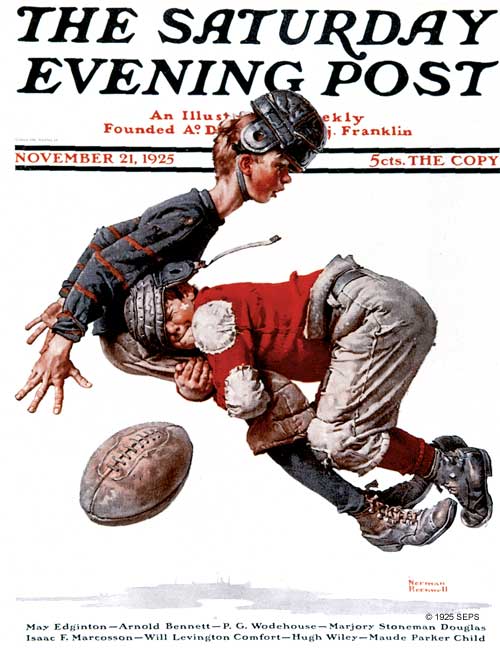
Norman Rockwell captured the less-structured and probably more hazardous play activity of an earlier time. His brush would have done justice to a number of Morris kids I remember. ("Saturday Evening Post" image)

A couple friends and I once built a soap box derby type of contraption for an informal competition in town. It was probably a little dangerous.
Notice I didn't say "racer," I said "contraption."
Several race crews gathered at the downhill slope on the east side of the old school. It was the typical type of childhood activity where we were self-starters. One imagines a Norman Rockwell type of painting. Maybe I could suggest a Dennis the Menace strip panel too.
Boomers often did things like this. Our enterprise was admirable. The activity itself might cause the parents of today to shudder. We played sandlot baseball in the same spirit.
We mustn't become too nostalgic because there were defects. Bullying could sprout and be undeterred. This current push to eradicate bullying probably gives boomers pause. We grew up under the laws of the jungle. We'd leave the house and do things unsupervised.
We gathered at the school hill and sent our "racers" down, testing to see who had the best approach. The kids at the bottom of the hill had better look out for what was coming down. The same held true with sledding. It was a madhouse with no adults to be seen.
I was reminded of that romp years later when watching an episode of the Red Green show on Public TV. The determined but calamitous Mr. Green had advice on making a good soap box racer. "The key," he said, was "large wheels."
I laughed because this was an area where my little group (of three, including the late Skip Sherstad) went wrong. We used wheels off an old stroller. Make no mistake, we deserved credit for our effort. Our engineering judgment was nonexistent. We moved onward, learning from mistakes.
Today kids are steered toward organized activities. They grow up in a time where any parent caught not using a child car seat might be stoned to death. Children's activities are supervised and structured. Parents probably sign forms agreeing to certain terms.
There are "waivers" where a slight risk factor might be presented. I'm sure lawyers hover over anything. Even waivers don't provide an airtight protection from legal action.
Kids aren't treated as human beings, they are treated as rare collectibles. There's no Norman Rockwell painting for the type of things kids do today. We have certainly built facilities for them.
I recently wrote about the "sandlot" days of hockey in Morris. "Sandlot" is figurative and applies to the ragtag nature of kids' activities once, when we needed to come up with our own amenities like bases for baseball.
We'd gather at the old elementary playground for baseball. We were spoiled having such an expansive playground available. Today the buildings and grounds are totally idle. The community could come up with no fresh use. A part of town that was once abuzz with the activities of youth is now idle.
I remember it was a challenge to try to glide down that slope in winter as if you were skiing, only you were wearing shoes. Terry Rice was good at it. Many of us ended up on our rear end. We'd laugh.
Today it would all be considered dangerous. We'd probably be chased away.
We played baseball without uniforms. The hockey kids were off on their own, using whatever adequate outdoor ice they could find, undaunted in enjoying their sport. Today the kids don't even have to think about the basic resources for their sports. We have an "infrastructure."
Can you imagine a Morris without a Lee Community Center? That's the Morris I grew up in. Varsity basketball was still being played at the old elementary auditorium/gymnasium. We had what you would call a "neighborhood" school. These were once the norm but seem to have fallen out of favor.
The safety-obsessed parents of today seem to insist on some distance from the real world of neighborhoods and adults going about their business.
Instead we have these "prison" schools. That's not my term, as I picked it up from a Morris Area school board member. She noted that so many new schools of today look like prisons out on the outskirts of town.
This sure makes me look at them in a different light. I admire the analysis this term reflects. They certainly look like prisons.
I was always reminded of the quote when driving past the KMS school.
The Morris school has grown like a monstrosity on the southern edge of the community. We are to be commended because the school isn't totally out beyond the town. Federated Church is right across the street, for example. So I won't call it a prison school.
But our culture is definitely protective to the maximum, which is fine in principle. We want everyone to be safe. But I think sometimes we need to encourage more of a notion of kids looking out for themselves.
A recent "Friday Facts" email included a notice from our police chief on the proper caution when driving near a school bus. Some very responsible people have been ticketed for violations in this regard.
I suspect many such violations aren't egregious. The police chief would probably disagree with me. A law is a law and it reflects proper judgment, he'd say. He'd better think that way, I guess.
I should state here that I have never received such a citation. A former Morris mayor has gotten at least one.
I'm not sitting here arguing that what these people did was totally safe and should be disregarded.
My argument is that in an earlier time, we expected kids to try to be responsible and careful on their own, up to a degree. When you're getting on and off a school bus, you should know there are cars out and about around you, so just be careful and look around.
Applying this to the computers of today, kids should know, and I'm sure they have the intelligence to know, there are risks and dangers out there and one ought to be vigilant about communications from any stranger. Instead we go after any adult "crossing the line" as if the mistakes are totally theirs.
These guys caught on the Chris Hansen TV series are just "bozos," I have written before. They need some sort of sanction that will scare the heck out of them and be a deterrent, but I'm not sure we need to get out the orange jump suits.
Good grief, America already has a disproportionately large percentage of its population incarcerated. It's being noted throughout the world. I agree totally with Ron Paul and other libertarians on how we need to back off on drug offenses.
I read a while back about a law enforcement person in Minnesota seeking to pull over someone who had an outstanding warrant or some such thing. The suspect fled. There was a collision and people got killed including a young child. And what was the individual wanted for? "Drug charges," I read. I groaned.
Our Chief Beauregard is to be commended on thinking about safety and carrying out society's wishes on this. He knows his job. My task as an idle pundit or thinker (hopefully) is to give some historical perspective, to conjure up those Norman Rockwell images of kids on their own, with ragtag or nonexistent resources, being self-starters and learning about life's challenges.
No indoor ice for hockey. No major league facsimile uniforms for little league baseball. (We wore T-shirts at Wells Park.)
Today our little mob with the homemade soap box "racers" might be chased off. There might be liability issues with school property, of course.
I'm not the only one who sees things like this. We got to talking in church one morning over coffee about these societal trends. An acquaintance of mine who works at UMM commented: "The way we protect kids today, maybe we should just wrap them in Nerf until they're 18."
Maybe it's all for the better. Maybe I'm just showing misguided boomer bias.
In our teens we hardly set an example. We'd plead the Fifth answering questions about that.
Today we seem rather fat and content. Different generations will have their values.
History will judge.
- Brian Williams - morris mn minnesota - bwilly73@yahoo.com