"You'll never get ahead if you don't take care of what you have." - Doris Waddell, RIP

The late Ralph E. Williams with "Heidi" - morris mn

The late Ralph E. Williams with "Heidi" - morris mn
Click on the image to read Williams family reflections w/ emphasis on UMM.

Thursday, April 18, 2013

Runners and "The Little Engine that Could"

I remember writing about Micah Grafenstein when the young man from Hancock ran the Boston Marathon.
It's sort of like the Masters in golf. Golf tournaments are frequent but there's only one Masters. When a runner talks about Boston, there is a special air that makes that distinct. The aim of running Boston means the runner is aiming for the highest height.
I covered Grafenstein for the print media. There were a number of Morris area runners who also got my attention. They always told a story like climbing a mountain. You could also compare it to "The Little Engine that Could."
You might also want to play that original "Rocky" theme song in your head. These souls get out on the roads and trails on their own. They do it in rain, sleet and snow just like the mailman. We thought the sight of a mailman on Saturday might be gone with the wind. But there's a reprieve. The Postal Service and the government are in a tug of war that has gotten tiresome. Saturday delivery is proving as resilient as the mail carriers themselves.
I remember writing about a couple of Morris mail carriers who ran a marathon. You'd think those guys would need some rest. I hope the 26.2 miles had the effect of building up those guys' legs instead of wearing them down.
Running took off as a pastime in the mid-1970s. It had a fad quality for a while. We had that best-selling book with the red cover. Frank Shorter winning the Olympics marathon gave a push.
Boomers were attuned to self-improvement. They could also get a little obsessed or distracted. It was an element of this generation - that's my generation - that decided it wasn't good enough to call yourself a Christian, you had to be a "born again" Christian. Didn't Bob Dylan go through a phase like this? Ah, us boomers and our "phases."
Didn't we inspire the "yuppie" term? We're always inspiring something. Our parents went to church and considered themselves Christians. Many of my vintage would point fingers and say "that's not good enough." You had to "accept Christ as your personal savior."
I don't know, I think the "greatest generation" folks probably felt they had done that. The greatest generation spent their formative years just thinking about getting by, thus they would have found marathon running a totally peculiar pastime. Why would you want to torture yourself like this? To what end?
Is there some psychological explanation that the running practitioners would find disturbing if they learned it? I suspect there is. It's like self-flagellation.
We have conflicted feelings about our self-image. Somehow we feel some self-inflicted punishment is called for. Our parents survived the Great Depression and World War II. Those episodes of adversity were quite enough. They were real world challenges, not challenges of our own creating.
I write all this as someone who engaged in running himself. The fad drew me in for a time. This was between 1983 and about 1994. I scaled back when I began feeling pain in my right foot. Today there's no pain if I'm just walking for ordinary purposes. If I "dabble" in jogging again, the pain will return - not always, but often enough to become an impediment.
Runners tend to develop injury-related excuses. The pastime involves too few muscles and joints, therefore those points that get engaged get worn down and the injuries crop up.
I ran the Twin Cities Marathon three times, the first time well and the next two times with some injury excuses. I remember finishing the first one, in 1984, feeling triumphant and having a volunteer look me over and say "you look a little dry." While I had gotten very well-hydrated before that run, I hadn't taken in any fluids along the way. That is certainly not recommended.
My time in that marathon: three hours, one minute and eleven seconds. You can look it up. It's a very good time for someone with my relatively large body. I kept my weight around 170 pounds in those days - light considering my frame. My weight today? Let's use the words of Chris Berman when the ESPN guy once reported Kent Hrbek's weight: "200-plus pounds, and we won't say how much the plus is."
Many people around Morris thought I was a little excessive with my commitment. Tom Swenson reported this to me once. Was I? All I can say is, having kept my weight so low over a period of about eleven years was probably very healthy for me in the long term. Had I carried "200-plus" throughout, who knows?
I remember when the executive of the Minnesota Beef Council visited Morris once, he murmured something about me that he thought I couldn't hear. Someone had just told him I enjoyed the meal. He chirped: "It looks like he could use it." The guy's last name was Eustice. He thought I looked anemic.
If you have known me for only a few years, you might be unbelieving anyone could say this about me. Remember I'm a boomer and I go through phases just like all my peers. What's next? Well, we're going to conquer aging of course.
I am writing about running today because of what happened at the 2013 Boston Marathon. My information network in Morris informs me there were Morris people there. I have been told Jen Lund ran the marathon and finished just nine minutes before the explosion. She reportedly had two "cheerleaders" there: Sharon Martin (one of my favorite people) and Dorothy "Dot" Vick.
Apparently the three were spared any harm. Why the Boston Marathon? Of all things, why would a terrorist choose this storied event? It's a tragedy, as is any terrorist event. Bill O'Reilly might not like the word "tragedy" but I'll use it.
Shall I congratulate Lund on her accomplishment? I'm not sure I wish to congratulate anyone who runs this distance. It's excessive. The distance by itself proves nothing. If you were to train for, and run, three or four 10K races during the summer, and to try to run them hard, that's plenty! You might even say 5K is enough.
10K is 6.2 miles, 5K is 3.1.
At my age now, 58, an occasional brisk walk is quite sufficient. Our belated spring is an unfortunate impediment for this. Ride bike. But most important, eat a sound diet. Cut out the high-fructose corn syrup. There's no need to even belong to the RFC. Just live sensibly. That was sure good enough for "the greatest generation."
Do I miss running? It's a memory worth having. Do I miss writing for the newspaper? I miss having an income and I miss having health insurance coverage. But the end came for that, just as with running.
The workplace environment and demands became unacceptable - they were sucking all the life out of me. I will elaborate more on this at some time. I have waited because it's painful. I will quote from a document that was presented to me in the "boardroom." It called on me to do things that the paper never even carried out. It was immensely sad.
True, our communications environment has been turned upside down since I started. So it wouldn't be the same. But I still miss it. I miss just having a normal friendly relationship with some former co-workers. But I was crushed at the end.
- Brian Williams - morris mn minnesota - bwilly73@yahoo.com

Monday, April 15, 2013

Scratching our head about weather forecasts

It's 2:15 a.m. Sunday and we're supposed to be in a winter storm now. But nothing seems amiss. This happens not infrequently.
The word "warning" instead of "watch" is supposed to guarantee something bad. But I remember a couple months ago, a blizzard warning was officially on but nothing amiss had set in. To the extent the winds arrived, it ended up being not that bad.
The Weather Channel with its glitzy production would seem to guarantee us solid information. Its track record is really not that great. It seems so reassuring to see that day-by-day breakdown of the weather lying ahead for the week. Even after we have learned we cannot rely on it, it seems tempting to seek it out again, as if we just shouldn't question such a glitzy production.
As a side note, my perception of what's "glitzy" is affected by my age: 58. Young people take all this elaborate communications stuff for granted. They should step into a time machine and go back to the 1960s. Tune in to the Alexandria TV channel. It was right out of Petticoat Junction. ("And there's Uncle Joe, he's a-movin' kind of slow at the junction. . .Petticoat Junction.")
I remember when then-Congressman Arlan Stangeland got irate at weather predicting that was off the mark. A serious storm set in without adequate warning. The Congressman was in transit somewhere. I assume he was mad at the National Weather Service.
The reaction to that incident was predictable: It seemed that those in the business of predicting the weather decided to err on the side of predicting the worst. There's nothing to lose, right? If a blizzard is foreseen but none arrives, no harm done, right?
In our litigious age, the forecasters probably felt they were protecting themselves on liability grounds. Failure to predict bad stuff could get you in trouble. Erring on the other side was safe.
But of course it's not so simple. You want your forecasts to be taken seriously. If you fail in this and cause people to hunker down for a storm when they needn't do so, guess what? You've fallen into the "cry wolf" principle. You'll "cry wolf" and people will just shrug.
Maybe we should just admit here in Minnesota that weather has an ominous presence and we just need vigilance. But this shouldn't be needed in April.
It's Sunday, April 14, as I write this. We don't have just a few crusty patches of snow left. We have a white landscape. It's ridiculous. It's beyond what a lifetime Minnesotan might expect, and we can expect a lot.
How immensely therapeutic it would be, if we could get out to the bike trail by the river, visit the gazebos there and sense the re-awakening nature. How nice to put on a short-sleeve shirt. How nice to let some outside air in through screen windows. How nice to just take a walk. How nice to see some of the West Wind Village residents sitting outside to get some fresh air.
It's 2:35 a.m. Sunday morning as I write this. The bad weather was supposed to arrive at 1 a.m. and continue through 1 p.m. Sunday. I'll believe it when I see it.
Why am I writing in the middle of the night? I have difficulty sleeping through the night now. As most of you know, we had a death in the family in February. I was busy as a caretaker for that person in the last couple years of his life. I wish I was still doing it. But God has a plan. These changes come and we adjust to them.
Now that I have less work to do, I have excess energy and need less rest. So I awaken when the world around me is dormant. I have my steaming mug of instant coffee and squares of dark chocolate. Then I will often write something like I'm doing now. Time seems suspended.
The dog likes being taken out in the middle of the night. Maybe this is a scene out of "Petticoat Junction." Remember the "rural" trend in TV shows in the 1960s? We had Eddie Albert in "Green Acres" and Andy Griffith in "Andy of Mayberry." The shows probably reflected a yearning we had for simplicity.
It would seem we ought to yearn for that simplicity more today. Of course, we didn't have tech shortcuts back then that we have now. How did we get along at all without any special tech toys? Well we did. There was no immediacy for talking to someone. We could let time drag. We could get bored.
We waited to get the weather forecast. I can't imagine we were any worse off in that regard.
Communication is immediate today but that doesn't mean the forecasters are any sharper. We just think we can abide by those forecasts, presented as they are with such nice graphics on TV.
It's 3 a.m. now and there's still nothing amiss outside. Not a creature is stirring, not even a mouse. Our dog, "Sandy," is back to snoozing. He's 16 years old but holding his own fine. He has sled dog blood which I think keeps his legs strong. The legs can be the first to go. My father lived to 96. There must be something to be said for my caretaking.
 
J.C. Penney, RIP?
I remember early in my career in the print media, I referred to "Penney's" in an article. This was the common and accepted way of referring to these stores. But it was not formal or official. An editor changed my reference to "the Morris J.C. Penney store."
What? You didn't know we had a J.C. Penney store? We sure did and it was on main street. Then it closed and we would have to go to Alexandria. Now it looks like the whole J.C. Penney enterprise might be shuttering. Man the lifeboats.
Is the one in Alexandria still open? It was an "anchor" store at the shopping mall.
Can we imagine a world without J.C. Penney? Sure we can. Other behemoth companies have been phased out. It's creative destruction.
When I was a kid, "Penney's" was part of that whole model of clothes-buying where a clerk would assist you. I hated that immensely. You'd enter the men's clothing section and immediately you could use your peripheral vision to spot a clerk "descending" on you, weaving through the aisles in pursuit of you so he/she could ask "Can I help you?"
Even if you said you were "just looking" - why did we have to say "just?" - you knew the clerk would continue to be aware of your presence. It was a distraction at best. It made me less likely to spend money. I'm sure it even affected my wardrobe. I probably had some social anxiety disorder, but I suspect my feelings about this were shared by many others.
How wonderful we have a Wal-Mart today where we can go and examine clothing without being bothered.
If J.C. Penney goes under as is being predicted by many, I will not notice or care.
- Brian Williams - morris mn minnesota - bwilly73@yahoo.com

Friday, April 12, 2013

"Red Tails" movie gives us a dated lesson?

I couldn't make it all the way through watching "Red Tails" without having to take the dog out. I might have answered nature's call myself. Thus I was reminded of how long this movie was.
The creators actually considered something longer, an epic-type production that maybe had an intermission. Or, because George Lucas was involved, maybe we had a "prequel" or sequel on the drawing board.
I have never taken to the "prequel" concept. Why not just start the whole thing with chapter 1? Oh, because the prequel wouldn't be as gripping? Well, if it's not as gripping, it's probably not going to sell effectively.
"Red Tails" did not sell well as a one-shot deal. The public and critics were generally cool.
The Lucas name made me brace myself for lots of CGI (computer generated images). Indeed that's what we got. CGI isn't all bad but moviemakers need to remind themselves it's not real. I find by comparison that WWII movies of the 1960s (my youth) lose nothing for not having CGI. I wrote not long ago about the flick "The Bridge at Remagen" (Robert Vaughn). It's fascinating to see all the combat scenes replicated with "the real things" - tanks and planes etc.
"Remagen" was intense. Whoever made it seemed to be especially fascinated by tanks. This might be the only movie that shows how fast tanks can really go.
In "Red Tails" our gaze turns to the sky. A comparable movie from the 1960s might be "Midway" (Charlton Heston). Like "Midway," "Red Tails" shoehorns in a love story as if the creators just felt it was needed. Perhaps the "Midway" creators, in telling the story of the naval turning point of World War II, felt this movie would get waterlogged without a love story.
In "Red Tails" a flyer nicknamed "Lightning" spots a beautiful woman while aloft, and she's on the ground doing her daily chores. He then tracks her down. Boy meets girl. Somehow they find the time to develop the relationship to marriage talk. Oh, but he'll have to remain in Italy. That's a condition. In the end there's tragedy. "Lightning" doesn't make it. We see how the woman gets informed (like in the opening scene of "Saving Private Ryan" when a military vehicle heads up a dusty road toward the residence of a war mother in America's heartland).
War could be hell for the flyers of the 332nd fighter group.
It was General Sherman who said "war is hell." Actually that famous quote is a paraphrase. But "hell" it is.
I grew up during the Viet Nam War. My generation sees more of the tragedy and less of the glory in war.
In writing about "Red Tails," I fall into the same frame of mind as when writing about the Martin Luther King Jr. holiday. I suspect that the wonderful young people of today have a hard time understanding a world in which we had this rigid dichotomy of "whites" and "coloreds." "Caucasians" and "Negroes." Unspeakable contempt toward the blacks who got a moniker I won't even type here.
I suspect young people are puzzled. The old dichotomy became impractical if not morally unacceptable, a long time ago.
A rainbow culture grew. The idea of "skin color" as an identifying feature seemed to become downright stupid. Non-white people with no African connections became more commonplace. The "races" have mixed more.
So today, I don't think the average young person really assigns any weight, or makes any judgment, based on skin color. I'm sure there are exceptions. But there's no comparison to the previous era when racism could be institutionalized.
It's this awful institutional racism we see on the screen with "Red Tails." Hollywood isn't letting go of this. As I write this, we're seeing the unveiling of the movie "42" about Jackie Robinson. We're reminded there was a time when the so-called "coloreds" couldn't play major league baseball. People my age understand the historical context.
But again, I think young people are going to be a little puzzled. They are going to be revulsed seeing an era portrayed when the dichotomy of "whites" and "coloreds" cast such an unpleasant overtone over American life. They'll wonder what their ancestors were thinking. As well they should.
Racism will always be in the historical record. The Internet ensures that nothing can be covered up. But these big screen displays that accent all that bad stuff might be counterproductive. Is this one reason "Red Tails" didn't seem to go over particularly well?
I would say Lucas didn't help when he made racially tinged comments himself. These got lots of press when the movie was introduced. They stuck in my head. He talked about the tough road for getting financing for "an all-black cast." You'd think there were nothing but blacks in the movie. Actually a fair number of white faces are sprinkled around. This includes the stereotypical "bad guy" enemy character, a flying ace.
The bad guy seems much like the "Tavington" character in the Revolutionary War movie "The Patriot." In "The Patriot," the bad guy is way overdone, to where he's finally killed, it seems grossly overdue. The bad guy in "Red Tails" finally gets shot down by the flyer who fell in love and was to marry. "Lightning" kills "Pretty Boy" but he crashes and dies. This happens when the Red Tails are escorting the big bombers toward Berlin. "Pretty Boy" was in a new kind of Nazi jet fighter. The Nazis had some interesting new toys but they were toast.
Terrence Howard leads our "Red Tails" as Colonel Bullard. He advocates for his boys, trying to penetrate the racism.
The movie starts with the flyers doing "mop-up" type missions. They take on ground transport. We see them wiping out a rail unit. I guess the flyers felt demeaned or relegated to routine missions. But it sure looked intense and important to me. I see no reason they should feel disrespected being sent on such duty. In fact, didn't your typical soldier shudder at the prospect of real, intense conflict with the enemy? Weren't they thankful for the routine and non-dangerous days? Isn't it a natural human impulse to want to stay alive?
Yes, the soldiers would "do their duty." But I'm sure they didn't savor the actual combat.
We're told the 332nd fighter group ("Tuskegee Airmen") wanted higher-prestige missions. That's fine as far as it goes. But higher-prestige also spells greater risks.
At the end, the 332nd was supposed to be relieved by an all-white squadron en route to Berlin. Propaganda. The 332nd feels let down, as portrayed in the movie.
The relief squadron fails to show. So the Red Tails get their "glory" after all. Part of the price that gets paid, is that "Lightning" becomes a casualty. Thus he is denied the life that awaited him, one of marrying that wonderful Italian girl and having children and grandchildren. It's gone with the wind.
But the 332nd gets affirmed as a heroic war unit.
I suspect most war veterans don't put much stock in "glory." They're happy to be alive. The "glory" gets reserved for Memorial Day speeches. The young men who were killed would love to have foregone war. Their voices can no longer be heard. Instead we hear about "freedom isn't free." It isn't, I suppose. But what were we fighting for in Viet Nam? Was it really "freedom?"
Getting the bombers all the way to Berlin meant the war was winding down. All that remained was the miserable work of wiping out the Nazis. Most of the morale problems in troops' ranks were at this stage of the war - mutinous inclinations etc. That's because the war's outcome was determined. This is illustrated no better than in the movie "The Bridge at Remagen" in which cynicism is thick.
The Red Tails proved themselves. Should we have been surprised at all by that? Didn't the black troops come through in the movie "Glory" also? "Glory" was about the U.S. Civil War, for crying out loud. It was set 3/4 of a century earlier than World War II. How many times do these black people have to prove themselves? Of course they can fight.
Again, young people are going to be a little mystified. They can't conceive of a world in which there's a predisposition toward thinking people of non-white skin color can't adequately perform in battle. The "battle" itself seems primitive and rather pathetic, with waves of human beings sent hurtling against each other with tools designed to rip human flesh apart. If blacks could somehow be excused from this, or relegated to so-called "mop-up" work, all the more power to them, I feel.
I'm showing my boomer sensibilities here. "Make love not war."
Apparently the tails of the planes weren't painted red just to acknowledge this group of flyers. They were red because this was a new batch of P-51 Mustang planes that were designed that way. The 332nd takes these cockpits for their first mission protecting the "flying fortresses." The white guys were having a problem staying close to the big bombers. They'd take off trying to get "kills." The 332nd was guided toward showing more discipline, staying close and protecting. It was mission accomplished for the Red Tails.
These airmen eventually got the Presidential Unit Citation. Members were eventually welcomed into an officers club (a bar). Young people might wince and think "man, you mean it was a big deal whether they'd even be allowed in a bar? American soldiers? Was our society really that backward?"
It's remindful of the signature Robert Vaughn line toward the end of "The Bridge at Remagen." Hearing planes overhead, he asks "ours or theirs?"
"Enemy planes, sir," he is told. There's a pause after which Vaughn, an honorable German officer about to be executed, says "but who is the enemy?"
"Red Tails" tells a story that may be true, but maybe it should be relegated more to the (shameful) dustbin of history. And to the textbooks. And to the Internet.
War is hell. Maybe that's all we need to know.
- Brian Williams - morris mn minnesota - bwilly73@yahoo.com
Monday, April 8, 2013

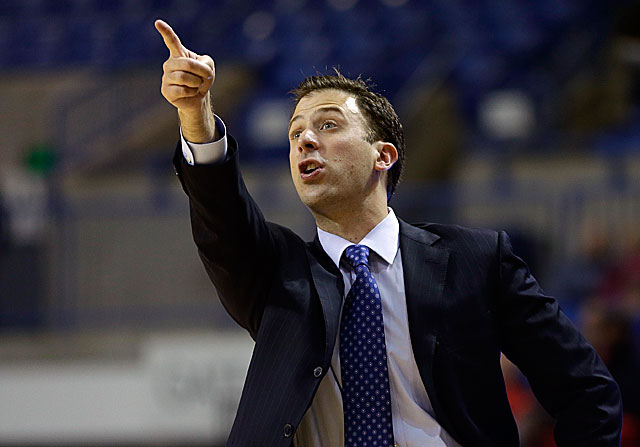
Rich Pitino is hyped, but let's await reality

Rich Pitino, new with the U (MPR photo)
Rich Pitino has been described as a "high risk-high reward" choice for the U of M. His age might suggest he's either "raw" or "hungry."
Let's suggest risk and raw as the operative words here.
We have seen a wave of attention for this story in the last few days. It affirms a point I made, or rather borrowed from George Will, last week. The Star Tribune treats this story with an overwhelming gravity. The U hires a new men's basketball coach.
The first edition to trumpet this put forth a fair amount of skepticism. Then, as if to backpedal, the "party line" optimism took over. No newspaper can risk being seen as arrogant or skeptical anymore. So now we're fed the party line about how Pitino, not to be confused with Rick Pitino who's the genuine, guaranteed-not-to-tarnish deal, is the proper and brave choice.
Instead of "risk" it's "reward." Instead of "raw" it's "hungry."
Unlike a newspaper I have no parochial constituencies to answer to. I can look at the emperor and see his clothing is minimal.
A big-time college athletic program doesn't really sell wins, it sells hope. We live in a new age in which people's attention span is whittled down. Way, way down. We yawn quickly when we sense an athletic program "isn't headed in the right direction." That won't do for long.
Since everyone cannot win, we see the tired routine of once-ballyhooed coaches who stagnate and then have to be shown the door. Often this is with a very sobering buyout figure ($2.5 million for Tubby Smith).
I'm not sure how much people really care about those buyouts anymore. They have come to be seen like numbers on a piece of paper, only. The same with other elements of largesse at our U of M. The Strib does an occasional expose on such matters. The Regents give knee-jerk quotes about how they ought to be paying more attention. But it seems the status quo persists.
I'm glad the Strib at least tries.
Richard Pitino has been a head coach for just one season. He's a mere 30 years old. These "young and enthusiastic" qualities could meet a brick wall from the elite coaches of the Big 10, who are noboby's fool. Don't think the intangibles of youth are any match for that.
We were sold the value of a proven commodity when Tubby Smith came here.
Rich leaves his job at Florida International. We learn that his team ranked 48th in the nation in pace of play, while our Gophers were 278th. Numbers can be trotted out to tout any coach. Again, Pitino's Big 10 competition is going to be quite savvy to counter any scheme the young man draws up.
We read so many cliches at a time like this. The departing coach is old news - a tired old subject. It's in no one's interest to talk him up. I wish Smith well at Texas Tech.
Smith's team here indeed had a spotty quality. But take a look at some of the "up" aspects. The Gophers got ranked No. 8 in the nation once. We beat the No. 1-ranked team at "the Barn." He made the NCAA tournament round of 32.
Oh, I certainly know there were negatives. The Big 10 is a wild and woolly place in which there are bound to be more negatives awaiting for our beloved rodents. As the witches said to Perseus regarding the task of getting the head of Medusa: "She's not going to give it to you."
Ol' Richie takes over a Gopher team that says adios to two of its top four scorers from a team that went 8-10 in league. We say adios to Trevor Mbakwe and Rodney Williams. They were mainstays in the frontcourt. We'll welcome back Andre Hollins and Austin Hollins to the backcourt.
Rich's Florida International team went 18-14 last season. We can cite Rich's assistant coach background prior to the maiden voyage. Except that I put no stock in assistant coach background and credentials. Baseball author Jim Bouton was outspoken in saying that people in a winning program, below the top person, are no guarantee for spreading that quality elsewhere. It's a myth we can succumb to.
Winning head coaches have a quality as if infused from Mount Olympus. They have a vision like General Grant in the Civil War: "total war." The assistants just fill their roles, like John Gutekunst did under Lou Holtz. Holtz was the genuine article, verbiage included. Gutekunst was a caddy.
So we really have just one year on which to base our optimism about ol' Richie.
The predictable quotes do get tiresome. Does this stuff really work anymore? I mean, like "he's a great guy, knows what he's talking about." And, "he has a reputation as a tireless worker and active recruiter."
I'm scratching my head. Aren't these qualities a given for coaches in the Big 10?
Chip Scoggins of the Strib considers the U coaching job only the eighth best in the conference. We have to try to sell "the Barn" at least in part on the basis of its history, as if the walls could talk I guess.
Apparently there's a need for a practice facility. Smith harped on this, which would have been fine if he had won more. Winning makes everything palatable. If Bud Grant had lost, he would have been an idiot for not allowing sideline heaters.
Men's basketball at the U has some incidents in its past. There was a reason Jimmy Williams was blocked.
Norwood Teague and Mike Ellis are the puppetmasters bringing Rich Pitino here. Heaven knows what lists they went over. Heaven knows what names were activated and deactivated.
Scoggins judges Pitino a "risky hire." The scribe cites the young and unproven qualities. The new job is "an enormous leap for him," Scoggins writes.
Rich won't outwit anyone in the Big 10.
The Teague-Ellis tandem, Teague being the top guy, have the distinction of being the first to jettison the venerable Tubby Smith. They somehow allowed this firing news to reach the national media before it was reported to Smith. How slipshod. Perhaps that speaks volumes about where University of Minnesota athletics is headed.
We now have what Patrick Reusse calls "a 30-year-old former student manager with a famous surname."
I guess we'll run it up a flagpole and see if anyone salutes it. Opie Taylor at the helm.
- Brian Williams - morris mn minnesota - bwilly73@yahoo.com
Friday, April 5, 2013

Vikings found their digs just fine in 1961

Pro sports team owners know what restaurant owners know. A periodic change in decor is necessary. A restaurant accomplishes this with some cosmetic adjustments. Maybe it's subconscious, but the patrons expect and desire this.
The situation with sports teams: Hell's bells, the "requirement" is to build new stadiums.
We were distracted long enough by the process of getting the new Vikings stadium OK'd. Now we're distracted by the fiasco of learning the funding mechanisms are going haywire. The electronic gambling has a short circuit.
I haven't been to the Metrodome in years. I have found big-time sports less necessary among my entertainment options.
Also, sports has become more acceptable to consume on television. There is probably less of a lure about "being there." 
The ones who still feel that lure, where the Vikings are concerned, are "20-somethings" who wish to act rambunctious and blow off steam or whatever. A thorough op-ed in the Star Tribune last fall documented this. Families with young children are advised to be wary.
Big-time football has a problem with saturation. Troy Aikman pointed this out in public comments not long ago. 
This is a common problem with all popular products. The public demands more of it. To an extent they'll get it, although the team owners are aware of the potential diminishing of value. Nevertheless they'll dispense more because there's money to be made. A line might be crossed. The public begins to yawn.
The league ensures more passing as opposed to the running game. Until, passing begins to develop a cheap quality. Frequent scoring has been no pathway to popularity for arena football. Does arena football still exist? I thought arena football had great potential when I first read about it. Good thing I'm not an investor. Singer Tim McGraw saw potential. Stick to your singing, Tim.
The NFL has been the epitome of the golden goose. When I was pre-school age, living in St. Paul I might add, neither the Vikings nor Twins existed. (We rented the house of a snowbird couple one winter and were supposed to take care of their cat, named "Pepper." The cat never accepted us. We've been dog people since.)
Today we're told the Vikings "need" a new stadium. Back when I was about kindergarten age, we marveled at the mere existence of the Vikings.
The Vikings have had two stadium homes up until now. Of course, we were told the Vikings "needed" the Metrodome. It was probably an easier argument to make for the Vikings than the Twins. The winter weather can be too punishing. But when it wasn't, the original stadium was a quite acceptable and pleasant place.
We're talking about Metropolitan Stadium, Bloomington, where today we have the Mall of America. I like to remind people that "the Met" could be a truly wondrous place. And it surely was on September 17, 1961, when our purple Vikings debuted.
Pete Rozelle himself was here. The opener date seems late compared to today. Weather blessed that historic first Vikings game. "Brilliant" was one word that was offered.
The Vikings were a totally new team unlike the Twins who moved here from Washington D.C. Expansion teams in that era were known to get roughed up a lot, exhibit 'A' being the 1962 New York Mets.
So, how would the Vikings fare? Our purple crew took the field to play the venerated Chicago Bears. You might not remember the name of our first general manager. It was Bert Rose. Bert actually was not pleased with the opener attendance: 32,236. Yes, it seems like quite the modest turnout. But I'll wager that crowd was 100 per cent more civilized than a typical fan turnout for a game today.
Bert had hoped for 35,000 fans. His hopes were fueled by how the Vikings performed.
The players weren't nearly as big or fast then, as they are now, so injury issues weren't as pressing. But was football any less fun to watch? The Vikings beat the Bears 37-13. Fran Tarkenton was 21 years old. He wasn't the day's starting quarterback. Instead it was George Shaw taking the snaps. Shaw ended up a trivia answer.
And Tarkenton? He impressed himself into Minnesota history. It was both a heroic and tragic story as he would end up losing three Super Bowls. There was a fourth: the Super Bowl we lost with Joe Kapp as quarterback.
Four Super Bowl losses! It gave the state's boomer population a bit of a defeatist outlook, finally salved to a degree when the baseball Twins won the championship in 1987.
Tarkenton entered that first-ever game as Shaw's replacement late in the first quarter. We led 3-0 at the time. Here's another trivia answer: Mike Mercer kicked a field goal on the game's opening drive. Hold on to your seats. Here comes the "Georgia Peach," Tarkenton, and he passes ten yards for a touchdown to Bob Schnelker.
Tarkenton ended up completing 17 passes in 23 attempts - phenomenal numbers - for 250 yards and four scores.
George Halas was still coaching the Bears. He said afterwards "I helped Minnesota get into the league, but I never intended to be this cooperative."
Mel Triplett was our fullback. Our middle linebacker had a terrific name for that position: Rip Hawkins. The coach was Norm Van Brocklin who failed to develop rapport with Tarkenton.
Bud Grant made his debut at the Met as head coach on September 10, 1967. The Monkees were all the rage. The Viet Nam war was at its worst.
Grant presided for the four Super Bowl losses. He was a father figure to us boomers. He never liked the fact the Met was built for baseball. He was quoted saying "the Twins made sure that we knew everything was theirs."
I don't recall football fans being too down on the Met. The occasional extreme cold had to be unpleasant. We prided ourselves on our hardy qualities.
Metropolitan Stadium had a big league feel in every way. And to think that in 1960, we had neither big league baseball nor football. In 1960 we still had the Minneapolis Millers. Before 1956 all we had was Nicollet Park, home of the Millers.
Today we have developed delusions of grandeur about what our big league sports venues should be like. We have allowed the business tycoons of sports to lead us around, delude us, intimidate us and downright scare us. These aren't bad people, they're just business people. They always try to get the best deal they can.
And on the other end we need someone stronger than Mark Dayton. We need someone representing the state's interests competently. We need someone who realizes that wholesale changes aren't always necessary. Sometimes we just need to tweak the decor as with a restaurant.
We all better just do a Hail Mary when that new Vikings stadium rises up. It will be populated by those 20-somethings. Heaven help us all.
- Brian Williams - morris mn minnesota - bwilly73@yahoo.com

Monday, April 1, 2013

Coaching search: around and around it goes

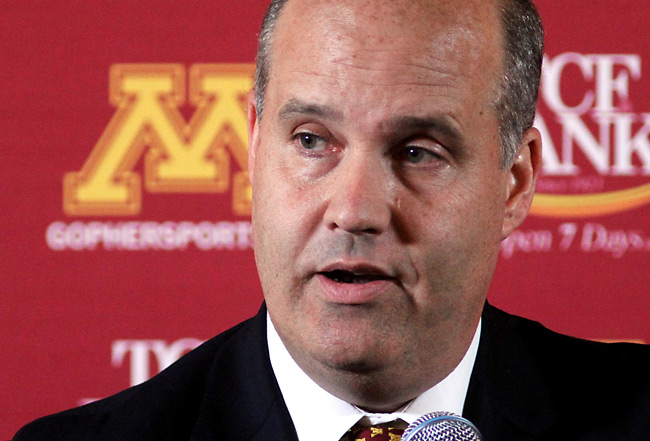
Norwood Teague, U of M
Surely it's a sign of age that I express weariness over another head coaching search at the U of M. But maybe not.
Maybe my sigh, in a figurative sense, is shared by others. Maybe I'm sick of what George Will calls "coach centrism." Will was talking about big-time college football. He talked about how college sports evolved from a more laid-back time. It is certainly seen in basketball too even though the numbers aren't the same.
A football coach seems to have a virtual army of players to deploy. They cover all sorts of refined specialties. The rules structure of football has allowed the game to progress like this, to where you need a savvy "chessmaster" kind of head coach. Maybe a better term would be "general" (as in army).
Football has historically seemed like war. But the public appears ready to start putting the brakes to that. The public has awakened to the barbarism.
Basketball doesn't have that problem. Basketball doesn't involve an "army" of athletes on each side. But the ones who do go out there and play are in a fishbowl. And, the coach is no less a chessmaster than in football. All our hopes and dreams get pinned on the head coach.
Division I college athletics has developed into a many-headed hydra that has to respond to demands and pressures. Fans get an absolute "sugar high" from the naming of a new head coach.
Rarely does a new head coach just sweep everyone off their feet and win a national title. It sure doesn't happen at our U of M.
We seem to want such heights to be reached. We're hearing all the usual catch phrases now. In the aftermath of the Tubby Smith firing, we hear these lofty goals expressed by program spokesmen. We want to win of course but that isn't enough.
The pronouncements at a time like this are "shooting for the moon." We want players of high character who are fine scholars and of course will graduate, oh but we want them to win the Big 10 title. We have been on this carousel before.
Athletic Director Norwood Teague is saying the right things. He talked about deficiencies in Smith's "body of work." I would suggest "body of work" has become one of those trendy terms or phrases, like "it is what it is," that will show up on end-of-the-year lists of overused, cliche-like terms or phrases. Leave it to an AD to utter something like this.
What on earth does big-time college athletics have to do with academics or education anymore? The games are pure entertainment. The infusion of money is corroding.
The University of Minnesota wastes substantial money as it thrashes around trying to "win." And winning accomplishes what? Allows us to thump our chests as Minnesotans? Really?
Again, maybe I'm just getting old. It seems much ado about way too little.
And why have we allowed the head coaches to get on such a pedestal? Why are they like mini-generals in an arena with hotly felt pressure to win, with firing or removal the consequence of losing? We then look for a new messiah. That's what Mr. Teague is doing now.
For the amount of money of U of M wastes, there doesn't seem to be much of a return right now.
Every few months the Minneapolis newspaper tries to do an expose on waste or largesse in the U of M. Athletics is a frequent culprit, like with the $800,000 paid to get out of two football games which the U was afraid it might lose (to North Carolina).
We hear about largesse and then the press tries pinning down the U's Regents for comment. The Regents might just as well stutter like Mel Tillis. They always admit they "should have known more." They say "we'll try to do better." And then it seems the status quo just goes on.
If you think I'm being radical sharing such opinions, just check Arne Carlson's blog. Carlson is a much-respected former Minnesota governor with a "mainstream" reputation. He is known to love the U. And he has some serious reservations about how resources are being used there now.
I'm not sure how much the public cares. The public seems like a big hibernating bear, having to be kicked to wake up to the ridiculousness of the Vikings stadium package. It's like pulling teeth. Some scribes with the St. Paul newspaper are issuing cries on that. Leave it to them. Oh, and me too (LOL).
St. Paul is used to getting the short end of the stick on a lot of things. Those writers are in a position to truly see how a certain power network is shafting the citizens of Minnesota. Ruben Rosario is one such writer. So is the crafty old scribe name of Joe "Sooch" Soucheray.
I remember Soucheray from when he was a young up-and-comer. He even looked a little like a hippie once. It's nice to see him get off the subject of property taxes for a change.
I'll be surprised if the new Vikings stadium ends up as anything but a white elephant. Post mortems will be written. If something on this scale was really necessary, couldn't it be shared by more than one team?
As for our U of M, we are back on that familiar carousel where soon there will be a press conference announcing the new men's hoops coach. Oh, how predictable that will be. This will be an "outstanding individual," squeaky clean and with awesome intelligence to be sure. But we hear that every time there's a new hiring.
Fact is, the Big 10 is filled with coaches who have roughly the same credentials and intelligence. The programs have roughly the same resources. They all grovel for money from every conceivable source. And here's the deal: They can't all win. Do you realize that? Yes, each game played has to have one winner and one loser. It's totally a 50/50 deal.
"Success" means having to overpower your opponents. You need to try to scrounge a few more resources than your rivals. And even then you'll need some luck. It is not a rational process to find a "winner." It's just a carousel.
And it never stops spinning.
- Brian Williams - morris mn minnesota - bwilly73@yahoo.com

Saturday, March 30, 2013

Take a balloon ride, do a Hail Mary

We looked skyward in the 1980s and saw an occasional hot air balloon in Stevens County. The first Donnelly Threshing Bee I covered for the print media had a hot air balloon attraction.
Midday ballooning seemed rare because any wind could quickly bring complications.
It seemed so peaceful and serene, those balloonists up there. The Fifth Dimension had that popular song with the lyrics "Up, up and away" in that "beautiful balloon."
We don't seem to see these objects anymore locally. Maybe the hobby isn't as peaceful as it seems. Might there be quite substantial insurance costs?
Controlling a hot air balloon would seem to have its issues. Isn't this clear in the closing scenes of "The Wizard of Oz?" Dorothy was about to be taken home to Kansas. The eccentric pilot seemed at the mercy of the balloon. Dorothy would end up having to tap her heels together. We don't know what happened to the balloon. The pilot was the guy who played "The Great and Powerful Oz."
"Pay no attention to the man behind the curtain."
Do you still remember the "balloon boy" incident? The media aren't helping us remember it. The media became profoundly embarrassed focusing on this episode for several hours. And you wonder why media people are cynical? Why they're so quick to suspect the worst in human motivations? It's not just because of Watergate. We are surrounded by charlatans.
Cable TV news was taken for a ride, so to speak, in the "balloon boy" incident. Wolf Blitzer came to the rescue at the end. The hard-hosed reporter, prodded I'm sure by that journalistic virtue of cynicism, coaxed an admission by the guilty family. He actually coaxed it out of the young child. Bless the children for they see things as they are.
A balloon incident is part of Minnesota history. It has faded into some obscurity. It was a minor regional story at the time. Cable TV news would have fixed that today.
Cable news would have gathered like bees around honey in December of 1969. It was truly "balloon boy" with no contrived element at all. It was truly dangerous. And it must have looked just like that closing scene in the "Wizard."
You see, controlling these lighter-than-air crafts seems to be at least half the challenge. The date is December 14. The backdrop is a Minnesota Vikings football game. A substantial amount of snow fell during the game. This was pre-Metrodome when the elements were fully a part of our sports viewing experience.
Outdoor sports in December? My but we're hardy folk. It's a testament to the popularity of the Minnesota Vikings.
Fans gathered at our old Metropolitan Stadium which was built for baseball. They gathered to watch the "purple people" play the San Francisco 49ers on that mid-December day in '69. Ballooning was a halftime attraction. The idea was to promote the St. Paul Winter Carnival balloon race.
There are those who might suggest St. Paul is a jinxed city. I don't know about that, but the halftime show hardly went as planned. The plan was for a balloon with its red and white stripes to merely glide the length of the field. A young man named Ricky Snyder, 11 years old, and his mom boarded the gondola.
The Snyder family owned the balloon. The "best laid plans" started going haywire. These things are certainly more dangerous than they appear. Safety wasn't guaranteed with five men holding a 200-foot mooring line.
The balloon was a little stubborn leaving the ground. Ricky's mom decided the weight in the gondola needed to be lightened. So, she got off. Whoa! The balloon took off as if on sudden impulse. The mooring line came loose. Whoa!
Ricky is now a genuine "balloon boy" and in a way spelling real hazard.
The first potential hazard was the left field light towers. (I told you the stadium was built with baseball in mind - we use baseball terminology.)
Ricky, seeming just like that eccentric guy in "The Wizard of Oz," barely missed the towers. Oh my, what next?
Southeast Bloomington opened up in front of him. He was at the mercy of his unwieldy craft. Again, what are the insurance costs for this pastime? Ricky had never before flown without a tether. His trip would cover three miles. An account tells us he "guided" the balloon to a "splashdown." Perhaps he was controlling the heat input. But would anyone seek a "splashdown" in a river in December?
I'm sure Ricky did the best he could, but his predicament seemed very real when he ended up in the Minnesota River. All that really matters is that there was a happy ending. The balloon tipped on its side. Ricky had about 25 yards to swim to get to shore. An at-large motorist spotted the odd scene, was certainly thankful to see the young man healthy, and gave a ride back to Metropolitan Stadium. A Vikings physician attended to the young man.
Young Mr. Snyder hadn't been hurt at all. Hallelujah.
But wait a minute, there's still an element of disorder going on. The Snyders and Winter Carnival people had taken off in pursuit. They knew nothing of the rescue. Such quaint times: no cellphones, not to mention no immediate gathering of the cable news people.
The situation became more confusing when the balloon just refused to sit still in the river. It had life left in it. It got reinvigorated just like the inflated "Otto" character during the movie "Airplane" - the "auto pilot," remember? The balloon rose off the river. It glided a ways more before coming down in some mud flats near the Black Dog plant of Northern States Power Company.
It's hard to believe confusion could reign for so long! It's hard to believe a mere random motorist would pick up Ricky, when in fact we might expect "gawkers" to gather. But those were different times, we must remind ourselves.
The Snyder parents waded through snow and mud only to discover the empty gondola and no Ricky. The caveman type of communications we evidently had then finally caught up. The stadium and the "chase crew" got on the same page.
Ricky probably wished he just could have clicked his heels together like Dorothy. This was no dream fantasy. And it was no "balloon boy." Or, let's say it was "balloon boy" but in the most real, non-contrived sense. And who the heck cares how the St. Paul Winter Carnival balloon race turned out?
Ricky claimed he never got real scared. He estimated being up about 1,000 feet. He remembered being in the clouds. His mother complimented him on his pilot work. But I can't imagine that a river splashdown in December would represent any sort of successful resolution.
We can be profoundly thankful this young man survived it. It's too bad Wolf Blitzer wasn't around to do the interview.
The Vikings beat the 49ers 10-7. This was the Joe Kapp era. Kapp passed 52 yards to Gene Washington for the game-winning touchdown in the final quarter. Snowmobile suits were everywhere.
A storm passed through in the first half, leaving in its wake two-plus inches of snow. Measuring for first downs became an issue. The storm ended for the second half and the sun actually came out.
Kapp and Washington did their thing but the defense had a big role too. Remember, these were the defense-fueled "purple people." Kapp just rode the gravy train for a while. Earsell Mackbee recovered a fumble and made an interception. Roy Winston made another key interception.
The problematic weather hardly held down attendance. There were over 40,000 shivering souls there, to see not only the Vikings' heroics, but Snyder as the real "balloon boy."
- Brian Williams - morris mn minnesota - bwilly73@yahoo.com