"You'll never get ahead if you don't take care of what you have." - Doris Waddell, RIP

The late Ralph E. Williams with "Heidi" - morris mn

The late Ralph E. Williams with "Heidi" - morris mn
Click on the image to read Williams family reflections w/ emphasis on UMM.

Friday, July 19, 2013

MN sports assets becoming bridge too far

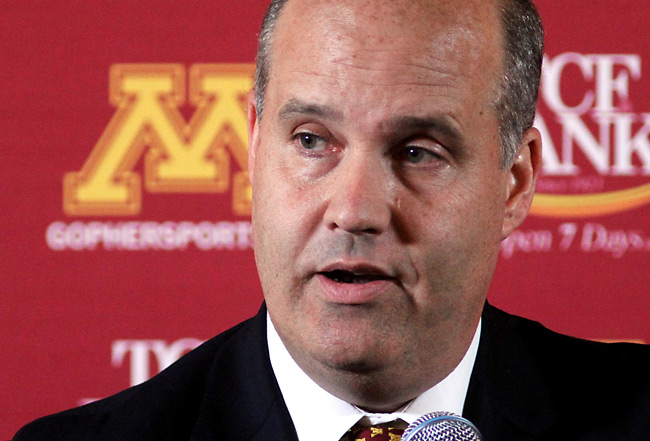
Norwood Teague, AD at U of M
"Someday I'll be your boss." That's a saying that a young person might choose for the front of a T-shirt. It's defensive. What it means is that "even though I haven't been blessed with athletic gifts that wow you and make you admire me, I do have attributes. I'll show them someday. I'll be your boss."
Certainly we all have mixed thoughts about big-time sports. We alleviate the drag of our day-to-day lives by watching sports on TV performed by individuals so distant from us, they might as well be space aliens. We don't connect with these people at all. We might as well be watching a metal ball bounce around under the glass of a pinball machine.
For every athlete who makes it to a post-game interview, where we might sense his humanity a little, there are hundreds who have crashed and burned, having "not made the cut" or gotten old, injured, beat-up, whatever.
We pay no attention to those individuals on the scrap heap. We just want to see a collection of healthy and gifted athletes representing our state, city or educational institution outrun and outjump the competition on a weekend afternoon. They had better succeed. They had better win.
They had better keep delivering that sugar high for us.
The people who own these enterprises had better keep drawing the money in, so as to enhance that competitiveness versus foes who are in the same system. In Minnesota the magnet-like pull is incredible. That's because we succumbed to the NFL's siren song that dictated we needed an opulent new home for the Minnesota Vikings.
The inevitability of that was scary. The average person likely says "why in heck do we need a stadium other than the Metrodome?"
Logic lost. The opiate of the masses, a.k.a. big-time sports lulled us. The levers of state government got pulled, greased by the incredibly big-money types, and now we shrug, having apparently accepted that we need increased gambling and certain types of taxes to subsidize.
It's a pill we swallow in order to be assured that the Vikings stay here and command our attention on autumn weekends. That pinball machine needs to keep making noise. We can't seem to find better ways to stay enriched.
We keep putting quarters into the pinball machine which has human beings, not metal balls, getting bounced around and so often discarded due to the ravages of age or getting beaten out by younger, fresher bodies.
 
U of M plays the game too
Because of the new Vikings stadium, we now have the University of Minnesota in a position of trying to catch up. The U has tried to close the gap for years with all too rare instances of doing so.
The position of the U of M Gopher football team up through the 1950s got whacked. My generation, the boomers, clearly chose the purple Vikings as "our team." The U continues to want to change that. That's fine as far as it goes.
But now we have an athletic director, Norwood Teague, a most contemporary corporate type of thinker, a man of money more than X's and O's, who certainly is talking money - there's no doubt about that.
I view the new Vikings stadium as a bridge too far. The same might be said of Teague's grandiose plans. We might shrug about such plans if they were discussed in the world of pro sports. Jerry Jones builds an obscenely extravagant new stadium in Dallas. That's one thing. It's another for an institution that I believe is educational in purpose, the U of M, to lay out a blueprint with a pricetag of $190 million. That's just for improvements.
The message is that athletes are a preferred and coddled class that must be catered to outside the standard academic framework.
Norwood Teague tells us we need an "academic center" for athletes. Isn't the U itself an "academic center?"
He says we need a "training table." Haven't colleges always had cafeterias? We need a women's gymnastics facility, an Olympic Sport indoor practice facility, an outdoor Olympic sport track and a wrestling training facility.
Mr. Teague expects that it will be 6-8 years before the first phase of the project is built.
Much of this impetus seems to come from having to keep up with other Big 10 schools. At what point does this "arms race" become counterproductive and superfluous for everyone?
OK, we're told the $190 million will be "private money." As if it's "play money."
"Don't worry, it's private money." When I was a kid, $190 million would have sounded like all the money in the world. We would have pronounced it like Dr. Evil. In our Wall Street-drenched world of today, wildly high numbers seem to lose their impact on us. They are numbers that just float around.
But, what else might this $190 million accomplish? What else might it be applied to, that would have a greater effect of improving people's lives? Corporations with such money at their disposal might actually be more generous with the people that work for them, that is, those people who aren't discarded because of "new efficiencies" that networked computers and tech in general are making possible.
These corporations turn a blind eye to real needs. They feed that arms race of big-time sports. They feed that opiate of the masses instead of really helping the masses.
Oh, we can still enjoy sports. It's never going away. But it doesn't need to be elevated to the Sodom and Gomorrah level, where we all know it gets far more resources than needed. We shrug and accept the inevitability of the new Vikings stadium. And now we're expected to shrug about the University demanding an astronomical amount of money - I use that adjective in paying homage to Willie Martin - so that the U might thump its chest and show primacy in athletics.
Let the teams compete with the resources they have. Not everyone can win. Think of the pressure those so-called student-athletes are under. They come and go, as do the coaches.
The real inside world of big-time sports is brutal and unforgiving. We the fans don't want to be bothered by that unpleasantness. That is, with exceptions, as many of us are now truly awakening to the hazards of the sport of football. The awakening is such, the future of the sport may very well be in peril.
Keep in mind this is one of the two major revenue sports in Division I college athletics.
This crescendo of awareness is not going unnoticed by the legal and insurance worlds. Lawyers and insurance companies may well start applying a vise to the sport.
People will still want to watch the Gophers and Vikings on the football field on weekends. Fans will want to watch even if they have conflicted feelings. That's why we'll have to rely on forces other than market forces to push football away from its mesmerizing hold on us.
Lawyers and insurance companies will slowly congregate, not to "spoil our fun" but to clean up a very real mess. The feeder system for football will become endangered, as soon as this fall I suspect, as parents wisely decide they need to take care of their own kids.
How much effort does it take to steer boys away from football to soccer? It could be done in a heartbeat. All these grandiose plans of Zygi Wilf, Mark Dayton, Norwood Teague and Eric Kaler could have their foundations threatened, by forces much bigger than Big 10 opponents.
What if the "higher education bubble" bursts? Already there's some evidence it has begun. What if the overall U.S. economy should implode, as we discover that the Federal Reserve has just been buying us time since 2008?
We will come to our senses. We will realize the ridiculous extravagance of big-time sports. We will pronounce "$190 million" as Dr. Evil would.
And we'll have more respect for kids wearing T-shirts saying "someday I'll be your boss."
- Brian Williams - morris mn minnesota - bwilly73@yahoo.com

Tuesday, July 16, 2013

Summer festivals, the rain and the future

The Morris Centennial gave us a preview of what Prairie Pioneer Days could look like. The Centennial has receded in time. It was in 1971, a century after Morris began as a rough-hewn tent town, planted here thanks to the railroad.
Before the railroad we really were the "wild west." The Wadsworth Trail with its horses, wagons and hazards pre-dated those iron tracks. Historians will suggest we stayed quite wild for a time. We couldn't have been more wild than Moorhead, about whom Will Rogers said it was "the wickedest city in the world."
The Morris Centennial really brought Morris alive in that summer of '71. Otherwise we were a pretty laid-back place, sans any kind of comparable summer event.
You might think city leaders would want to parlay that Centennial spirit into subsequent summertime fests. It didn't happen in summer but it did happen for fall. We had the Fall Festival for a time. My top memory is of Lee Temte entertaining at East Side Park. There was no Killoran bandshell then.
Scheduling a fall fest has risk because weather can turn on you. I'm not sure that was ever a problem. I recall that the Fall Festival was more small-time than what came later: our Prairie Pioneer Days (PPD).
I was involved in promoting the inception of PPD. This I did as a print media writer and photographer. I remember how exciting it seemed. It made total sense to have a gala midsummer event here.
I was a musician for the "German band" that wandered and played for the Morris Centennial. I remembered the atmosphere and thinking how neat it would be to re-create it. Our little band, supervised by high school band director John Woell, stepped into the Met Lounge for a few minutes - exciting because for some of us, it was our first visit to the interior of a bar. I would have been 16 years old.
In 1973 the drinking age got lowered so I could legally drink as an 18-year-old. Surely that was dubious status to have. It was folly for our nation to do that, but we felt it necessary since, after all, we were asking young men to fight and die in Viet Nam, for reasons I still don't understand.
The Morris Centennial saw the re-creation of the full-scale alfalfa arch. That was a tremendous undertaking that celebrated the spirit of the community as much as anything could. There is a large photo of the 1971 alfalfa arch on a wall at Willie's Super Valu. I would have been in it had I wanted to, but I didn't make the effort. I regret that.
A miniature version of the alfalfa arch was constructed across East 7th Street for a period of years in PPD's history. The Morris FFA did that. Hats off to them, as this gesture reminded everyone of the grand spectacle in 1913 when Morris and the alfalfa arch were synonymous. Click on the link below to see a photo of the arch in 1913. The photo is from the Minnesota Digital Library.
 
The miniature arch was phased out. Indeed, it seems Prairie Pioneer Days has lost some of its long-time spark. I'm not the only one noticing that. I would want it confirmed by others before writing it.
I spend only a small amount of time at PPD now, compared to when I was in the print media. Keep in mind I'm older! As a young man I'd go back and forth between the old Morris Sun Tribune office building, now vacant, and the park and other places.
I hope I get some credit for having ridden my bike out to the midway point of the 10K run, along the bike trail, to take photos! I remember the lead runner, Bart Abbott one year, coming toward me and me wondering if I should distract him by asking his name (for caption purposes). Bart didn't mind! He glided past me out through the pristine-like surroundings near Pomme de Terre River.
Yes, I wrote captions for my Prairie Pioneer Days photos! Since my departure from the Morris newspaper, that operation has cut corners and just thrown together a whole bunch of photos in a collage minus captions. It's much harder work getting caption information as you make your rounds. I felt it was something I just had to do.
The Morris newspaper was twice a week then. The page size was bigger too. Seriously, I think the decline of the Morris newspaper is a factor in PPD losing some of its spark. The mid-week edition was good for reviewing events of the previous weekend and previewing events of the coming weekend. For many years we were Tuesday/Thursday of course. We had ample opportunity to build up to the weekend. That's all gone with the wind now.
The paper's emphasis now is on showering us with dumpster-ready ad circulars, many of which steer us to Alexandria. I think all community news should just migrate online. To an extent it's happening but not as fast as I once anticipated.
By now you all know that the 2013 PPD was pretty much obliterated by rain. No parade! It takes a lot to cancel a parade.
Might the parade still be salvaged? It would be smaller and lower-key, but there might be a route in Morris that could accommodate it on short notice.
Many of the community's youth groups had planned on riding on parade units. They'd still be delighted to do that. How about a parade along Park Avenue in west Morris? It would conclude at Wells Park, actually a more spacious park than East Side Park. At Wells the kids could get off their units and organize for recreational activities like perhaps soccer or softball. A couple food vendors could get set up.
What fun! We could be reminded that Park Avenue was once "the drive of the city," an especially high-class place where horse-pulled buggies would proceed along on summer evenings. Perhaps some people wearing period attire could greet the parade units from the front lawn of the Stanton House. West Morris could "get its due."
My current post on my "Morris of Course" site expands on this history of west Morris, while acknowledging that we need some street repair there now! Click on the permalink below to read. Thanks!
 
What does the future of Prairie Pioneer Days hold? Some people are going to have to show initiative.
Up next: the Stevens County Fair! See you at the 4-H foodstand.
- Brian Williams - morris mn minnesota - bwilly73@yahoo.com
Saturday, July 13, 2013

Boys of summer win in Legion ball

Morris 7, Osakis 0
The Post #29 boys won with a shutout flourish on July 9. The score was 7-0 in this American Legion baseball action.
The win was No. 11 on the season for the surging Morris squad. The loss total: a mere two.
Bryce Jergenson excelled again on the hill. Bryce has been most stingy giving up hits. He tossed a three-hitter which was in fact his second straight three-hitter. Bryce was stingy in every conceivable way as he walked none. He set down six Osakis batters on strikes. His mates played errorless ball around him.
The Morris line score: seven runs, eight hits and no errors. Osakis managed just three hits and committed two errors.
Morris took care of its scoring business in the fourth inning. All seven of the Motown runs came home in that frame.
Tanner Picht wielded a hot bat, finishing at three-for-three with two RBIs and a run scored. Danny Tracy had two hits in three at-bats including a double, and scored a run. Jacob Torgerson went one-for-three with an RBI and run scored. Mac Beyer had a hit and drove in two runs. Logan Manska had a one-for-three line with a ribbie and a run scored.
The losing pitcher was Grayson Fortenberry.
 
Hancock 11, Starbuck 8
Wow! In one of the more exciting Legion baseball games you're likely to see, Hancock escaped a deep deficit to beat Starbuck.
Starbuck jumped out to a 7-0 lead in the first inning. Hancock managed to score just one run over the first five innings.
The game's complexion changed markedly in the sixth. The game changed to the tune of a ten-run Hancock rally! When the full seven were complete, the Hancock Legion boys could celebrate an 11-8 win.
It was a nice confidence-builder for the Hancock athletes who are below .500. The Thursday, July 11, win over Starbuck was just their third. Sub-district playoffs are set for this coming week.
Hancock's Thursday success was despite getting outhit 10-6. There's no big discrepancy in errors either, where the Starbuck total was two and Hancock's three. No Hancock player had more than one hit. Austin Steege went one-for-two with two RBIs and two runs scored. Andrew Shaw crossed home plate twice.
Danny Lonneman rapped a hit in three at-bats, drove in a run and scored two. Brandon Shaw had a one-for-four line while driving in three runs and scoring one. Other batters hitting safely were Jordan Miller, Justin Miller and Bryan Shaw.
The Starbuck hitting standouts were Austin Ostrander at three-for-three with an RBI, and Michael Gruber with two-for-three numbers and a ribbie.
The Hancock pitching was handled by Brandon Shaw and Collin Cunningham. Cunningham got the win with his four-inning stint. Collin struck out three batters, walked three and allowed three hits. Brandon Shaw had some bumps in the road as he allowed seven hits and seven runs (six earned) in his three innings. He fanned a batter but walked six.
Hancock will strive to parlay their sixth inning momentum into sub-district play!
 
Hancock 8, Wheaton 7
The eighth inning saw the Hancock Legion baseball boys seize the decisive momentum. This was in the Friday, July 5, game versus Wheaton.
Hancock plated three runs in the bottom of the eighth to overcome Wheaton. Wheaton had rallied for two runs in the top of the eighth.
The bats were ringing with hits for much of this game. The hit total for Hancock was 14 which was two more than Wheaton. Hancock's line score was eight runs, 14 hits and three errors. Wheaton's numbers: 7-12-4.
The most decisive blow was probably Brandon Shaw's hit in the eighth that drove in the game-winner.
These Hancock batters finished with three hits: Taylor Holleman, Collin Cunningham and Michael Milander. Cunningham went three-for-four with two RBIs and three runs scored. Holleman added an RBI to his three safeties. One of Milander's hits was a double.
Bryan Shaw had a hit and drove in three runs. Justin Miller, Andrew Lindor, Brandon Shaw and Bryce Schmidgall were the other Hancock batsmen recording hits. Lindor and Brandon Shaw each drove in a run.
Hancock scored one run each in the first and second innings, two in the fourth and one in the sixth, leading up to that big three-run eighth.
Wheaton's hitting was paced by Peder Schmitz and Braden Krump who each pounded three hits.
Lindor pitched seven innings and got roughed up some, but it doesn't matter considering the winning outcome. Two of the seven runs he gave up were unearned. He struck out three batters but gave up ten hits.
The pitching win was picked up by Miller who gave up one run which was unearned. Miller gained the "W" with his one inning of work.
The losing pitcher was Tanner Kirkeide.
- Brian Williams - morris mn minnesota - bwilly73@yahoo.com

Wednesday, July 10, 2013

Outlook of "baby boom cohort No. 2"

Trumpeter Clark Terry was a quite masterful "scat singer." Perhaps you're familiar but if you're not, how to describe? It's like playing an instrumental "bebop" jazz solo only you use your voice, not an instrument.
What's "bebop?" Let's just say it's very fast as opposed to "cool jazz."
Terry recorded a scat singing showcase that had only one understandable word. That word was at the end, uttered very abruptly, bringing laughs of course from the audience. That word was "Watergate." That notorious word coming from the depths of a boomer's existence seemed to blend in with a scat-singing song.
Watergate was all about deception, lying, nefariousness, sneaking around etc. It stood to reason that scat singing with its unintelligible syllables would be consistent with telling the story.
Eventually of course the whole story came out. Historical annals tell us the news media were the heroes. This impression was built when the entertainment industry got ahold of the story. It was a stretch to make Watergate entertaining but it got done. We got a major motion picture with Robert Redford and Dustin Hoffman.
The movie had the same name as the book leading up to it: "All the President's Men." Wink, wink: This was a takeoff on the nursery rhyme about Humpty Dumpty ("all the king's horses").
Hollywood can exaggerate. But I'm not sure there was much if any exaggeration in the story as presented in the movie. Watching the movie "cold," you might think there's no way two mere newspaper reporters could change history. Surely there are heavy-hitters in the government who would take over. In a sense they did, I feel, in that they just got out of the way.
There were powerful people who let Richard Nixon hang himself.
We the voters had elected Nixon. And despite all the eulogizing for George McGovern when he died, this Democrat was stigmatized as "too left" when he was in the prime of life. So Nixon got elected, a man who assuredly knew where all the levers of power were in Washington. He was the vice president for eight years under Dwight Eisenhower.
In 1962, delivering perhaps the most ironic quote in U.S. history, he told the press "you won't have Nixon to kick around anymore."
Nixon could have lived out the rest of his life most happily and successfully. But having been in the corridors of power, it was an elixir he could not resist. He'd not only seek a return, he would use every conceivable lever known to him, including the non-legitimate ones, to secure his power. 
 
"Cohort No. 2" and its times
Watergate gives a backdrop for that portion of the population known as "baby boom cohort No. 2." Boomers are generally thought of as people born between 1946 and 1964. The so-called "cohort No. 2" was born between 1956 and 1964. Of course there are no absolute lines of delineation. I was born in 1955. My Morris High Class of 1973 had its 40-year reunion recently. I attended for about one-half hour of the festivities.
I think we can conclude this class got imbued with the qualities, generally speaking, of the baby boom cohort #2. Wikipedia tells us that Watergate influenced us. Many of my peers might laugh at the suggestion that Watergate actually influenced them. They'd laugh and say the whole thing was just ridiculous. It certainly seemed to be ridiculous, but does this mean we should just write it off as having been frivolous?
These were our nation's leaders at the vortex of something seen as "ridiculous." Should we not expect more?
Boomers had watched as our nation's leaders led us into the Viet Nam War. We were in the throes of a miserable withdrawal process as we graduated from high school. We of course tried to put the bad stuff out of our minds as we gathered for commencement.
You'd never know anything was amiss on that pleasant early-summer evening in 1973. But in fact we were dragged down, subconsciously anyway, by a world around us that hardly seemed to inspire optimism. We should be so lucky as to associate the 1970s only with disco! The Cold War hovered.
I don't think we suspected "communism" would implode on its own. I put the word in quotes because even Mikhail Gorbachev seemed perplexed by it. Perhaps the word was largely an invention by fear-mongers in the U.S. Gorbachev eventually just shrugged and said he equated the word with "organized crime." Anytime leadership is not duly elected, I suppose it's a crime.
Watergate affected our consciousness even though we might laugh at the suggestion. I believe the movie did well.
Oh, the drinking age got lowered for baby boom cohort No. 2, as a "favor" to us. Well, thanks a lot. Society retreated from that of course.
We came of age in a time when the stock market had a much different image from today. It was sort of a remote, exotic and risky place associated with rich folks. Of course, real rich people don't take many risks.
One of the biggest puzzles in my life is how Wall Street went from that exotic place, to a place where all the common folks of the U.S. were supposed to put their money, in things like 401Ks. Today we wake up in the morning curious about how the "S&P Futures" are doing. Dear Lord, what has become of us?
My peers and I came of age with inflation raging. I swore it would be a constant. A fellow named Paul Volcker eventually came along and solved that.
We had to withstand a recession. We survived gas shortages. Jimmy Carter never actually used the word "malaise" but we felt it.
Wikipedia tells us that baby boom cohort No. 2 picked up traits of being "less optimistic (than the norm), feeling distrust of government, and a general cynicism."
If you're a boomer, you might forget how cynical we were inclined to be. I mean, when you refer to the president of the U.S. as "Tricky Dick." Don Meredith referred to him this way on a Monday night football broadcast. He did have to apologize. But I'm sure he didn't "misspeak."
I remember a joking line among my peers: "Dick Nixon before he dicks you."
Today's young people grow up showered and surrounded with so much idealism, it's dripping and we seem to just take it for granted. We seem to feel we can create a utopia for our kids. Now we're attacking "bullying." My generation understood bullying as a natural extension of human nature that couldn't be eradicated.
We accepted a lot of very sober realities. Where is the future taking us? Heaven only knows.
I'll predict right here that our U.S. economy is going to implode in October or November in this year of our Lord 2013. My old associate Jim Morrison says it's likely to happen sooner. "The Fed" won't be able to save us anymore. Nor will a "bailout." Nor, "all the king's horses."
Oh, I hope I'm wrong. Baby boom cohort No. 2 knows bad things can happen. We endured the "Smokey and the Bandit" movies, after all.
- Brian Williams - morris mn minnesota - bwilly73@yahoo.com

Saturday, July 6, 2013

Morris and Hancock Legion teams prevail

Morris 4, Glenwood 1
Bryce Jergenson executed smoothly on the mound for the Post #29 baseball team in its win over Glenwood. Success came by a score of 4-1.
Hurler Jergenson flirted with a no-hitter. He had a no-hitter going into the seventh frame. He got dinged a little at the end but it was of no consequence for the game's outcome. Bryce got the "W" next to his name in the boxscore as his squad picked up its ninth win. He allowed three hits. He fanned seven batters and walked two.
Glenwood employed two athletes on the hill: Jake Amundson (who took the loss) and Austin Ostrander.
Morris gave Jergenson a 1-0 lead through the first three innings, before some cushion was created with a three-run fourth.
The Morris line score was four runs, 13 hits and no errors. Glenwood put up 1-3-1 numbers. Glenwood pushed across its lone run in the seventh which was when they finally broke through to hit safely vs. Jergenson.
The Morris Legion nine began their scoring when Mac Beyer doubled in a run in the first inning. Beyer had a heckuva boxscore line, coming up just shy of hitting for the cycle. (All he lacked was a home run.)
Morris scoring resumed in the fourth when Jacob Torgerson connected for a timely double, driving in two runs. Jacob then scored on a Tanner Picht base rap.
Glenwood may have finally hit safely vs. Jergenson in the seventh but they didn't exactly knock the cover off the ball. There were three singles. The tying run was at the plate when Jergenson squeezed his glove on a foul pop-up over by first base, to bring this game to a close.
Beyer had three hits in as many at-bats including a double, a triple and an RBI. Jergenson had two hits in three at-bats. Logan Manska was a perfect two-for-two including a double, plus he crossed home plate twice.
Torgerson's double was his offensive highlight. Picht finished at two-for-three with a run scored and an RBI. Connor Metzger had a hit in his only at-bat.
Tyler Henrichs went one-for-two with his hit a double. Austin Dierks had a one-for-two showing with a run scored.
The three Glenwood players hitting safely were Austin Ostrander, Jackson Hendrickson and Luke Nielsen.
 
Hancock 2, Clinton 1
The eighth inning made the difference as Hancock achieved the game-winner in American Legion baseball vs. Clinton.
The teams were deadlocked 1-1 through seven. Hancock pushed across a run in the eighth but still had to retire Clinton in the bottom of that frame. Bryan Shaw was up to the task on the hill.
It was a long and demanding outing for Shaw who had been the starter. He held Clinton scoreless in the eighth to polish off this 2-1 Hancock triumph on July 1. He struck out eleven batters in his eight innings. He walked five and allowed four hits.
The game was a true pitchers' duel that had Logan Nordly on the opposing end. Nordly like Shaw pitched the whole eight innings. Nordly set down ten Hancock batters on strikes while walking six and allowing four hits.
Each team had four hits. They matched each other in errors too, each with one (impressive for an eight-inning game).
Shaw had two of the four Hancock safeties. He went two-for-three with an RBI and a run scored. Andrew Lindor went one-for-three with an RBI. Andrew Shaw had a one-for-two line.
Zack Adelman had a multiple-hit game for Clinton.
- Brian Williams - morris mn minnesota - bwilly73@yahoo.com

Wednesday, July 3, 2013

"Mars Attacks!" more than superficial comedy

"Funny lookin' critters, aren't they?" Joe Don Baker says of the Martians in "Mars Attacks!"
These Martians were originally supposed to be presented using "stop-motion." "Stop-motion" is a laborious undertaking but it can have interesting results. The original "King Kong" was a showcase. The name Ray Harryhausen comes immediately to mind.
"Stop-motion" may have been on the drawing board for "Mars Attacks!" but it was not used. A more economical choice avails itself for Hollywood. That choice: computer animation. Indeed, computer animation (or CGI) was quite the cat's pajamas when it first came on the scene. After a while it became tired, which in my opinion is where it sits now. It worked fine for the 1996 "Mars Attacks!" cinematic release. It was the same year as "Independence Day."
The two movies seem remarkably similar in spite of different purposes. "Mars Attacks!" intended to be funny. I would argue it wasn't mere farce. It wasn't just a series of impulsively created gags. There was a thread of seriousness to it which I hope other moviegoers detected.
I would summarize that theme as pacifism
The Jack Black character was created as the ultimate GI Joe type of military fanatic. The military was supposed to protect our interests in "Mars Attacks!" Consistent with this is the Rod Steiger character, an absolute caricature of the Patton-like military leader. He assumes the worst about the Martians.
All the tanks and guns of the U.S. military were powerless vs. the "funny lookin' critters."
There seem to be three heroes in this movie, none of whom use aggression to get the favorable resolution. Lukas Haas as "Richie Norris" is the complete opposite of the Jack Black character. They're brothers in the movie. Richie is a calm, nerdy, thoughtful guy who runs a donut stand. He's very committed to his grandmother who ends up another of the three heroes. She emerges this way unwittingly with her music tastes.
Music! "Mars Attacks!" is somewhat like "War of the Worlds" in the sense that an unexpected adversary of the invaders emerges. Neither movie shows the military having any power. In "War of the Worlds" it's the bacteria, "the smallest living creatures" (irony intended), that do the vanquishing. In "Mars Attacks!" the force is similarly unlikely. It's the kind of music grandma likes.
Sylvia Sidney plays "grandma." What kind of music? She plays it on vinyl records. Think of Slim Whitman's "Indian Love Call." Yodeling saves the world. Richie learns of this by accident when attending to his grandma. The tables are quickly turned on the Martians.
Then at the end, we see the movie's third hero, played by Natalie Portman, bestowing honors. We have learned through the course of this movie that Natalie's character, "Taffy," completely lacks the pretentiousness of her parents who happen to be the president and the First Lady. It's hard to believe she could even be their daughter. She seems to be the calm and pacifistic type just like Richie. She and Richie keep their heads while everyone around them seems to be losing theirs.
Richie's simple love for his grandma is his bedrock.
"Taffy" has the presidential chef bring her pizza. She seems alienated like she's bothered by all the pomp around her. "Grandma" is a kind-hearted character who isn't totally attuned to reality. She lives in a nursing home.
Richie, Taffy and Grandma seem on a different page from nearly all the movie's other characters. It's as if they are in a different, saner reality. Yes, they are pacifists. They don't even think of an overt aggressive response to the Martians who really just seem like props in the movie. The three take care of their priorities, being gentle and sensible, and we get the assurance that things will work out fine.
Belligerence loses. It's not the guns that win, it's the bacteria in "War of the Worlds" and the yodeling in "Mars Attacks!" The invaders don't belong here. They'll be taken care of.
"Mars Attacks!" sticks with me a lot more than "Independence Day." I have written before about "Independence Day," that it doesn't wear well with repeated viewings. It goes from being an interesting spectacle to seeming ridiculous. The implausible aspects jump out at you. I don't like seeing an exotic dancer cast as sympathetic. How would anyone know how to fly that old captured UFO? It's as mystifying as "Rambo" hopping into that Russian helicopter and knowing where all the buttons are! That's Hollywood!
It has been suggested that "Mars Attacks!" is like a Mad Magazine satire of "Independence Day." Surprisingly, "Mars Attacks" did not do well at the box office in the U.S. Fortunately it did better in Europe.
Tim Burton was a creative brainchild. I think the movie is superbly crafted. The story is effective. The A-list of actors couldn't have done better. Those name actors must have known this was a significant project.
I'm surprised the movie got just mixed reviews. Roger Ebert made an odd comment, that the movie's creators gave the impression they were above the subject matter, whereas such movies succeed best when the creators have their sleeves rolled up with total belief - something like that. He was implying that the subject matter was something like schlock.
But I don't think that was the intent or the reality. I think the intent was to show an invasion scenario with comedic overtones that in the end was done in by the unlikeliest force. The three heroes as identified by yours truly would seem the unlikeliest. Yet they set an example with how they carried themselves. They kept their composure amidst all the madness. It's pacifism on a pedestal.
Everything represented by the Jack Black character came crashing down. Make love not war.
Jack Nicholson gets to play two characters: President "Jimmy" Dale and sleazy Las Vegas hotel developer Art Land. Annette Bening plays a character modeled after Ann-Margret in "Viva Las Vegas."
I should have acknowledged the Jim Brown character earlier in this post. Brown ought to be featured onscreen more often. As I reflect on "Mars Attacks!" the thought has crossed my mind that maybe the whole story was a fantasy in the mind of the Brown character. The story allows him to feel a renewed purpose in his life, to feel some of his past glory again, to thump his chest as "the heavyweight champion of the world" and to get back with his family from which he has been estranged.
Brown's character, "Byron Williams," is a once-great prize fighter now reduced to being a casino greeter. He helps a group escape the Martians. We assume he's dead but for some reason he has escaped their clutches, maybe because he humored them by boxing them? Did they just want to fight a little? He makes it back to his family's home of Washington, D.C. in a very climactic final scene. His character is a very gentle one. He refuses an offer from Art Land to rough up a guy who has crossed Land. Once again it's pacifism.
Let's add the Brown character as a hero in this movie. So many elements worked well together in the movie. Tom Jones plays himself in a most endearing and entertaining way. He sings his signature "It's Not Unusual." He flies the plane while Brown distracts the Martians with his boxing. Bening is on the plane.
We get so attached to all these characters.
"Mars Attacks!" has been described as black comedy and political satire. Also, as a parody of sci-fi 'B' movies. I'm disturbed by all the attempts to describe this movie in merely farcical or "spoof" terms. Such terms cheapen it. It was a uniquely inspired sci-fi story with obviously comedic overtones, but with an undercurrent of seriousness about pacifism, restraint and sensibility as alternatives to panic.
The Steiger character epitomizes the most undesirable character traits. "Taffy" scolds him in the movie, as he has just become too loud.
Way back when, actor Steiger was offered the role of Patton that was eventually taken by George C. Scott. Legend has it Steiger rejected the role because he felt the movie would glorify war. Which it did. "Patton" was made in 1970 when Steiger's attitude was very common. We should stick with it.
Danny DeVito, Sarah Jessica Parker and Michael J. Fox continue the A-list nature of the "Mars Attacks!" cast. The chemistry is perfect.
The concept for the movie began in 1993. It was weighed alongside "Dinosaurs Attack!" But the latter seemed too similar to "Jurassic Park."
An old trading card series planted the seed for "Mars Attacks!" It's the kind of story one might expect growing out of the Cold War, a strange time that was the backdrop for my youth. We feared "the other." We felt a military buildup with readiness was a must. We feared the Russians like we might fear the Martians.
I would compare "Mars Attacks!" more to "War of the Worlds" than "Independence Day." Substitute the yodeling for the bacteria.
My generation poked fun at Slim Whitman for a time after he'd become well-known with a TV album. My generation mocked many things and I hope we've grown out of it.
"Mars Attacks!" has staying power that in my mind far surpasses "Independence Day." Pacifism lives!
Kudos to "liberal" Hollywood.
- Brian Williams - morris mn minnesota - bwilly73@yahoo.com

Thursday, June 27, 2013

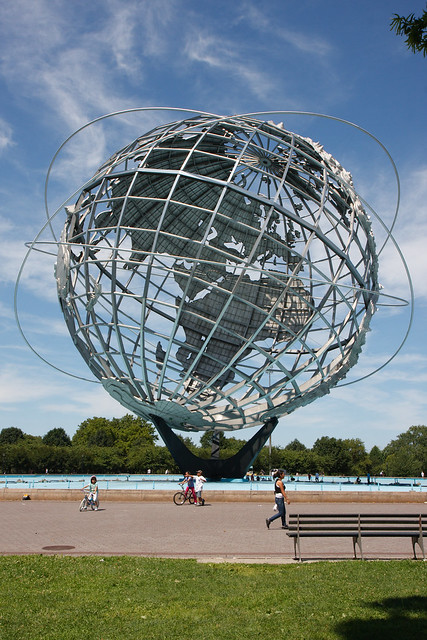
Why can't Unisphere become truly iconic?

It stands 12 stories high and represents the entire Earth. You would think such a structure would be impressed on our consciousness more. I have suggested in the past it ranks up there with the Eiffel Tower in France and Taj Mahal in India. But it does not enjoy that same iconic status.
The structure I'm talking about is the Unisphere. It even got a little boost in the 1997 "Men in Black" movie, when the story had it destroyed by a crashing flying saucer.
It would take a lot to destroy this spherical stainless steel representation of the Earth. It holds a special place in my heart because I was present for the 1964-65 World's Fair. People streamed into Flushing Meadows NY for that spectacular affair. The Unisphere was constructed as the symbol. Today it is one of the few remaining artifacts.
The World's Fair had an ironic theme: "Peace through understanding." Our country was in fact on the cusp of terrible divisiveness as we were to plunge into the Viet Nam War and experience other social tumult. The apex of the war was probably 1967.
The World's Fair had a peaceful and optimistic outlook that should have been borne out in our country's direction. It was not. But the purpose was noble.
The Cold War seemed to send certain forces spinning out of control. It was a strange and sort of paranoid time. The World's Fair sought to brush all of that aside, imploring us to think of peace and harmony.
Because of its purity in this regard, the Fair is a touchstone in the memory of boomers in the New York City area. And, for all who visited like yours truly who was there because of the University of Minnesota-Morris men's chorus. Our singing lads with their signature maroon blazers visited the World's Fair in Seattle (1962) and New York (1964). They helped put UMM on the map. UMM was in its fledgling days.
The men's chorus performed in a spirited way.
The Unisphere is a prevailing symbol in my memories. It rises up in its steel splendor in Corona Park, Borough of Queens. It was built not just to represent the Fair, but to celebrate the beginning of the Space Age.
Three rings circle it, representing the orbits of the first U.S. astronaut, the first Russian cosmonaut and the first communications satellite to orbit the Earth.
We learn that "locals don't pay much attention" to it anymore. Perhaps residents of Paris don't pay much attention to the Eiffel Tower either. But I would argue the Unisphere deserves the same iconic status. Occasionally we do see it in the background of a TV commercial or in other fleeting ways. But it's too fleeting and incidental.
The New York Mets were still a new team in 1964. Their home of Shea Stadium was so close to the fairgrounds, it appeared on fair maps. The '64 season was their first at Shea as they had moved from the old Polo Grounds in Manhattan. They were in their third year. They hadn't yet shook the image of mediocrity so well established at their inception.
The Mets played at Shea Stadium from 1964 to 2008. They went from being horrible in 1962 to winning the World Series in 1969. Their heroics in '69 were helped along by West Central Minnesota native and WCSA graduate Jerry Koosman.
My family strongly considered attending a New York Mets game during our stay for the World's Fair, as I remember. But we did not. There were so many things to do and see. It seemed endless.
You might say the New York World's Fair had a special atmosphere of class because it had no true midway. I'm talking a "honky tonk" type of midway. No, this World's Fair was a true exposition. And while this was classy and laudable, the lack of that midway probably hurt attendance. Organizers were hoping for 70 million. Instead they got 51 million.
Hey, the UMM men's chorus was worth the price of admission! Oh, and the admission price was $2 in 1964 and $2.50 in '65. For kids the price was $1. One dollar! What a value.
In addition to that theme of peace, so ironic, the Fair was planned as a showcase for mid-20th Century U.S. culture and technology. The Fair ran for two six-month seasons: April through October in 1964 and April through October in 1965.
It was also a grand consumer show. Many people got their first interaction with computer equipment. Back then we thought of computers as bulky, esoteric and kept in back offices away from the public.
I fondly remember the Sinclair "Dinoland" with its life-size replicas of nine different dinosaurs. Ford introduced its Mustang vehicle at the Fair. The Mustang ended up making an even bigger impression than the Unisphere.
If only the "Peace through understanding" theme had really spread across America and its leaders. It reflected such fundamental common sense. Instead we fell into the abyss of war, civil rights struggles and a generally turbulent time.
Young people fought to find the joy of life as they always do. They gravitated to the Monkees musical group. And of course we had the Beatles. Our family came upon a genial street vendor by our hotel in Manhattan who wore a Beatles wig! Remember the "mop tops?" The New York World's Fair coincided with "Beatlemania," that phase that began with "I Wanna Hold Your Hand."
The New York World's Fair has receded in our collective memory. But the Unisphere remains. It's like a rock, indeed, weighing as it does 700,000 pounds. The people who craft our popular culture should pay more attention to it. It should take no back seat to the Eiffel Tower or Taj Mahal.
- Brian Williams - morris mn minnesota - bwilly73@yahoo.com